
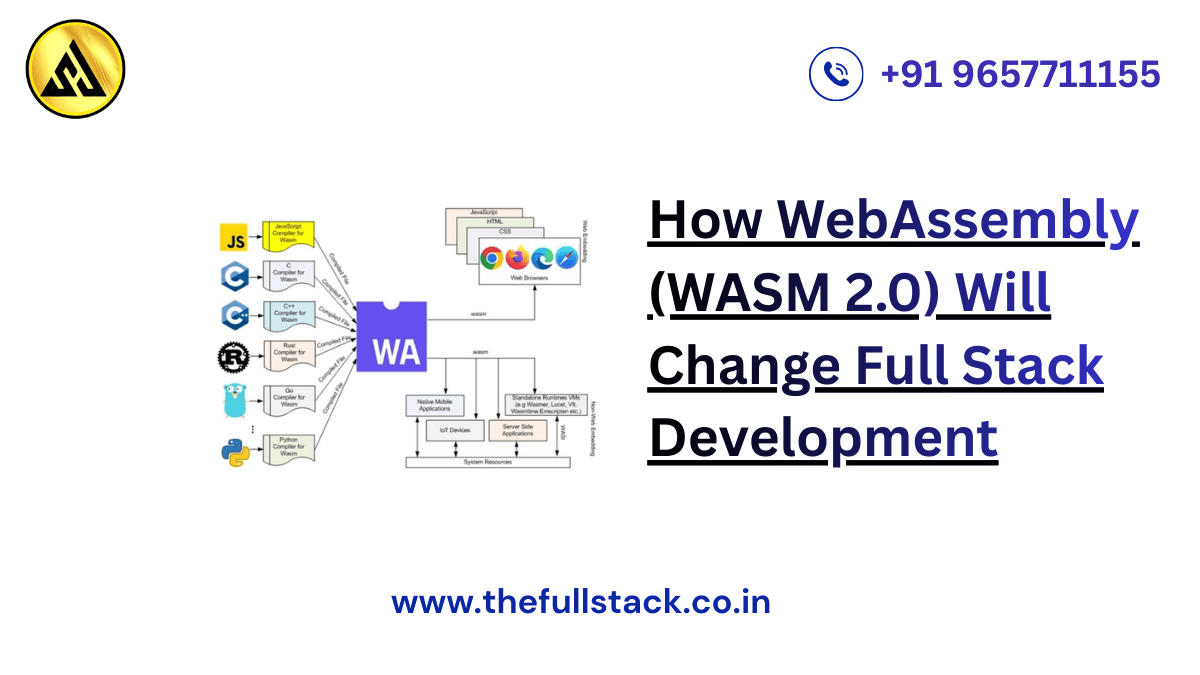
How WebAssembly (WASM 2.0) Will Change Full Stack Development
The web is evolving faster than ever, and one technology stands out as a true game-changer for full stack developers: WebAssembly 2.0 (WASM 2.0). Whether you’re a beginner learning to code or an experienced professional exploring performance-critical development, WebAssembly 2.0 is about to reshape how full stack applications are built, deployed, and scaled.
In this blog, we’ll break down what WASM 2.0 really is, why it matters, how it improves on the earlier version, and what real-world opportunities it opens for developers by 2026. You’ll understand how WASM 2.0 full stack development will redefine the architecture of web, cloud, API, and edge-based systems.
What Is WebAssembly (WASM) in Simple Terms?
Before diving into WASM 2.0, let’s quickly understand WebAssembly itself.
WebAssembly (WASM) is a high-performance, low-level binary format that allows developers to:
- Run code extremely fast
- Run non-JavaScript languages in the browser
- Build near-native performance applications on the web
- Share modules across frontend and backend environments
Think of WASM as a supercharged companion to JavaScript—a way to run heavy workloads without slowing the browser or the backend.
Languages that compile to WASM include:
- C / C++
- Rust
- Go
- Zig
- AssemblyScript
- Swift (experimental)
What Makes WASM 2.0 Different?
WASM 2.0 builds on the original WebAssembly with major upgrades:
1. Component Model Support
This is the biggest change. It enables WASM modules to work together like microservices, allowing true interoperability between languages without glue code.
2. Better Integration With Backend Runtimes
WASM 2.0 is designed for server-side execution, not just browsers. It now fits natively into:
- Cloud functions
- Edge runtimes
- Serverless platforms
- Backend containers
3. Lower Memory Costs
Improved memory models make WASM more efficient, allowing larger applications to run smoothly.
4. Native Capabilities Support
WASM 2.0 extends capability-based security for safer file access, network calls, and system operations.
5. Faster Start-up Times
Ideal for microservices, serverless apps, and API-first architectures.
With these upgrades, WASM 2.0 full stack development becomes a powerful new standard for both frontend and backend engineering.
Why WASM 2.0 Matters for Full Stack Developers
Modern full stack apps demand:
- Speed
- Security
- Portability
- Multi-language support
- Cloud scalability
- Edge compute efficiency
WASM 2.0 allows developers to meet all of these without rewriting systems or abandoning familiar languages.
Let’s dive deeper.
WASM 2.0 in Frontend Development
1. Near-Native Browser Performance
For years, web applications struggled to match desktop software performance. WASM changes that.
With WASM 2.0, you can run tasks like:
- Video editing
- Image processing
- Real-time 3D rendering
- Complex animations
- Mathematical simulations
—all directly in the browser without lag.
2. Multilingual Web Apps
You no longer need to build everything in JavaScript. Developers can bring Rust, C++, and Go code into the browser through WASM components.
3. Better Framework Interoperability
WASM 2.0 allows faster communication with:
- React
- Vue
- Svelte
- Angular
- WebGPU
- WebGL
This unlocks hybrid apps that combine the best parts of JavaScript and compiled languages.
WASM 2.0 in Backend Development
The real revolution comes with how WASM 2.0 impacts backend architecture.
1. WASM-Powered Serverless Functions
Platforms like Cloudflare Workers, Fastly Compute@Edge, Fermyon Spin, and Deno Deploy are already adopting WASM.
Advantages:
- Cold-start time < 1 ms
- Extremely low memory usage
- Portable across cloud providers
- Secure sandboxing without VMs
2. WASM as Microservices
WASM 2.0’s component model allows microservices to be:
- Language-agnostic
- Fast to deploy
- Securely sandboxed
- Consistent across environments
This will make full stack microservice development far more modular.
3. Universal Runtime for APIs
Imagine writing your backend logic once and running it on:
- AWS Lambda
- Cloudflare Workers
- Local servers
- Edge nodes
- IoT devices
WASM 2.0 makes that possible.
4. Database Extensions Using WASM
Postgres, SQLite, SurrealDB, and others now support WASM for custom logic inside databases.
This means:
- Faster stored procedures
- Secure execution
- Portable database customizations
Edge Computing + WASM 2.0 = Full Stack Reinvented
As more companies shift workloads to the edge, WASM 2.0 becomes the perfect runtime.
Benefits for full stack apps:
- Ultra-low latency
- Localized data processing
- Privacy-first user experiences
- Real-time analytics at the edge
By 2026, many full stack applications will run partially at the edge using WASM 2.0 modules.
Real-World Use Cases for WASM 2.0 Full Stack Development
1. Real-Time Gaming and Graphics
High-performance engines can now run in browsers using Rust or C++ compiled to WASM.
2. Offline-First Productivity Apps
Imagine Figma-like tools that load instantly and run offline with near-native performance.
3. AI and Machine Learning in the Browser
TensorFlow, ONNX, and PyTorch can ship WASM-powered inference models, reducing server costs.
4. Cryptography and Security
WASM sandboxes are perfect for secure, auditable cryptographic libraries.
5. Edge-Based Personalization
Full stack apps can personalize UI and content instantly at the network edge.
6. Embedded Systems and IoT
WASM 2.0 allows low-power devices to run portable components that can be updated on the fly.
How Beginners Can Start Learning WASM 2.0
If you’re new, don’t worry—WASM 2.0 is beginner-friendly if you approach it step by step.
Step 1: Learn the Basics of WebAssembly
Understand how the compiler converts high-level code into WASM.
Step 2: Pick a Language
Rust is currently the most popular choice for WASM.
Step 3: Build a Simple WASM Module
Compile a function to WASM and import it into JavaScript.
Step 4: Explore Frameworks
Try tools like:
- WASM Components
- WIT Bindings
- Fermyon Spin
- Wasmtime
- Deno + WASI
Step 5: Build a Hybrid App
A simple example:
Frontend: React
Backend: WASM microservice
Step 6: Dive Into Serverless + Edge
Deploy a WASM function to Cloudflare Workers.
This roadmap prepares you for the future of full stack dev.
Challenges of WASM 2.0 Adoption
Even though WASM 2.0 is powerful, beginners should understand the challenges:
- Limited debugging tools
- Smaller ecosystem compared to JS
- Learning curve with Rust or C++
- State management across WASM components
- Browser compatibility differences
But these issues are rapidly improving, and community support is strong.
What to Expect by 2026
Here’s what the future likely holds:
1. WASM-First Backend Frameworks
Frameworks written entirely in WASM will emerge.
2. More AI at the Edge
WASM will run inference locally without heavy cloud calls.
3. Browser Apps as Powerful as Desktop Apps
Native-like performance will become normal.
4. WebAssembly Package Managers
Just like npm, but for WASM components.
5. WASM 2.0 as a Cloud Runtime Standard
Cloud providers will treat WASM as a first-class citizen.
Simply put—WASM 2.0 full stack development will redefine how we build the web.
Conclusion: The Future of Full Stack Is WASM-Powered
WebAssembly 2.0 is more than an upgrade—it’s a turning point. By 2026, full stack development will look very different, with apps that load instantly, scale globally, run securely, and support multiple languages seamlessly.
If you’re a beginner, this is the perfect time to start learning. And if you’re already a developer, WASM 2.0 will be your next big skill advantage in the evolving tech landscape.
Call to Action:
Start experimenting with WASM today. Explore Rust, try building a simple component, deploy it on an edge runtime, and prepare yourself for the next era of full stack innovation.
What is AWS Lambda?A Beginner’s Guide to Serverless Computing in 2025
Java vs. Kotlin: Which One Should You Learn for Backend Development?

Leave a Reply