


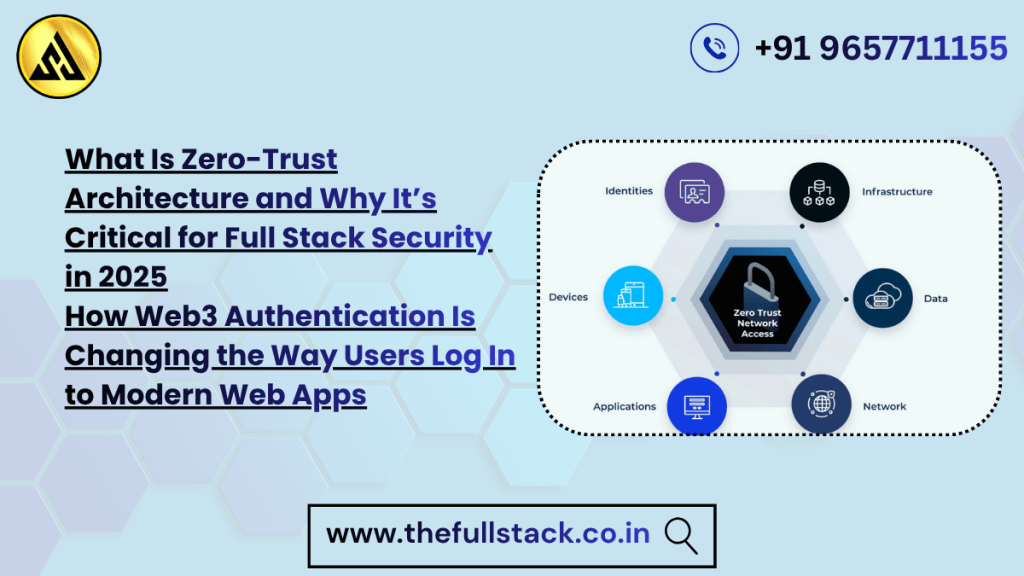
In a world where cyber threats evolve faster than the software designed to stop them, the concept of “trust but verify” is no longer enough. Modern organizations are moving toward a stricter, smarter, and more resilient security model known as zero-trust architecture. At the same time, emerging Web3 technologies are rewriting the rules of user authentication, empowering individuals with more control over their digital identities. Together, these two trends are redefining what full stack security means in 2025—an era where protection is no longer about walls and passwords but about continuous validation, transparency, and decentralization.
The digital landscape has changed dramatically. Remote work, cloud adoption, edge computing, and interconnected applications have erased the boundaries of the traditional corporate network. In this open environment, attackers no longer need to “break in”—they’re often already inside, exploiting weak passwords, compromised credentials, or unverified internal systems. This is precisely why zero-trust architecture has become a cornerstone of modern cybersecurity strategy. It operates on a simple but powerful principle: never trust, always verify.
Redefining Security for the Cloud-Connected Era
Traditional security models assumed that everything inside the network perimeter could be trusted. Once a user or device gained access, it was often free to move laterally across systems with minimal friction. This design worked when networks were closed and employees worked from on-site offices. But in the age of hybrid work and cloud-first infrastructure, the perimeter has effectively disappeared. The zero-trust approach flips this model entirely by assuming that every user, device, and application—whether inside or outside the network—must be verified continuously before being granted access.
In a zero-trust architecture, authentication and authorization happen dynamically, using contextual information like device health, location, user behavior, and network environment. For example, if an employee logs in from an unfamiliar location or device, the system can automatically trigger additional verification steps or deny access altogether. This approach not only strengthens defenses but also minimizes the damage if an account or system is compromised.
The rise of microservices, APIs, and distributed applications has made zero-trust especially relevant to full stack security. Every layer—from frontend interfaces and middleware to backend databases and cloud APIs—must be secured through identity verification and least-privilege access. Zero-trust ensures that no component communicates or exchanges data without validated credentials and encrypted channels, dramatically reducing the attack surface for modern web apps.
How Web3 Authentication Changes the Game
While zero-trust architecture focuses on securing access within organizations, Web3 authentication is transforming how users identify themselves across the internet. Instead of relying on centralized databases of usernames and passwords, Web3 introduces decentralized identity management powered by blockchain technology. This shift not only enhances security but also restores ownership of digital identity to the individual user.
At its core, Web3 authentication replaces traditional logins with cryptographic key pairs. A user’s private key—stored securely on their device—serves as proof of identity, while the corresponding public key is used by applications to verify credentials without ever exposing sensitive information. This process removes the need for password storage, third-party authentication servers, or vulnerable single sign-on systems that have long been prime targets for hackers.
For example, instead of signing into a web app using an email and password, a user can connect through a Web3 wallet such as MetaMask or WalletConnect. The wallet verifies the user’s identity via digital signature, allowing them to access decentralized applications (dApps) or even conventional websites that integrate Web3-compatible authentication. This not only simplifies the login experience but also makes phishing attacks and credential theft nearly impossible since no password or token is transmitted over the network.
The Intersection of Zero-Trust and Web3 in Full Stack Security
The combination of zero-trust architecture and Web3 authentication creates a powerful new model for full stack security—one that blends continuous verification with decentralized trust. In traditional systems, the weakest link is often the user credential. Once compromised, attackers can gain access to everything the credential unlocks. Web3 mitigates this risk by replacing passwords with cryptographic identities that cannot be easily stolen or reused. When paired with zero-trust validation policies, every action within an application can be verified, logged, and encrypted.
Imagine a scenario where an enterprise web app uses zero-trust principles to manage internal access while leveraging Web3-based login for external users. Employees and partners could authenticate using decentralized identities stored in their own wallets, and the zero-trust system would continuously assess device integrity, location, and behavioral signals before granting or maintaining access. This hybrid model not only ensures airtight security but also aligns with the growing demand for privacy and transparency in digital ecosystems.
Moreover, zero-trust and Web3 share a philosophical alignment: both reject implicit trust and emphasize user control. Zero-trust removes blind trust from corporate networks, while Web3 removes it from centralized identity providers. Together, they represent the evolution of digital trust—where security is dynamic, distributed, and user-centric.
Real-World Applications in 2025
By 2025, many leading organizations are already adopting zero-trust frameworks as a standard practice. Tech giants like Google and Microsoft have integrated zero-trust principles into their internal and cloud offerings, while governments across the U.S. and Europe are mandating zero-trust adoption for critical infrastructure. For startups and small businesses, cloud-based platforms such as AWS, Okta, and Zscaler offer scalable zero-trust solutions that can be implemented without massive infrastructure changes.
At the same time, Web3 authentication is rapidly expanding beyond crypto wallets and decentralized apps. Social media platforms, e-commerce websites, and even traditional SaaS products are beginning to experiment with decentralized login systems that enhance user privacy while simplifying the onboarding process. For example, imagine logging into your favorite online marketplace or streaming service without ever creating an account—simply connecting your digital wallet and instantly verifying your identity. This seamless, secure experience is what makes Web3 authentication so promising.
In full stack development, zero-trust and Web3 principles are increasingly being embedded directly into the application architecture. Backend APIs can use tokenized access controlled by zero-trust gateways, while front-end layers integrate decentralized identity verification. The result is an end-to-end system where every request, transaction, and data exchange is authenticated and auditable in real time.
Why It Matters Now More Than Ever
Cyber threats are growing not just in volume but in sophistication. Ransomware, phishing, supply chain attacks, and insider threats continue to plague businesses of all sizes. As digital transformation accelerates, companies must ensure that their security strategies evolve faster than the threats they face. Zero-trust architecture addresses the reality that breaches are inevitable—but compromise doesn’t have to be catastrophic. By minimizing implicit trust and enforcing continuous verification, it limits the blast radius of any intrusion.
Simultaneously, Web3 authentication tackles one of the most persistent security weaknesses: password management. According to multiple studies, over 80% of data breaches involve weak or reused passwords. By eliminating passwords entirely, Web3 reduces the risks of credential stuffing, identity theft, and centralized data leaks. Together, these innovations create a future where authentication is seamless, security is proactive, and users truly own their digital presence.
Building a Secure, Decentralized Future
The convergence of zero-trust architecture and Web3 authentication marks a pivotal shift in how we think about security in the digital age. This is not just a technological upgrade—it’s a cultural and strategic reorientation toward continuous trust evaluation and decentralized control. For businesses, adopting these principles means future-proofing their systems against emerging threats while building deeper trust with customers and employees. For developers and IT teams, it means designing applications where security isn’t a layer added at the end, but an intrinsic property woven through every component of the stack.
As we move deeper into 2025 and beyond, the organizations that succeed will be those that see zero-trust not as a compliance requirement but as a mindset—and those that embrace Web3 authentication as a pathway to more user-centric, privacy-first applications. The future of full stack security lies in uniting these paradigms to create systems that are not only resilient but also transparent, efficient, and adaptable to change.
Now is the time to act. Explore our advanced guides, expert-led workshops, and certification courses designed to help you implement zero-trust principles and Web3 authentication in your organization. The future of cybersecurity isn’t about locking doors—it’s about redefining what trust means in the digital world. Learn, build, and secure your stack for the decade ahead.
What is AWS Lambda?A Beginner’s Guide to Serverless Computing in 2025
Java vs. Kotlin: Which One Should You Learn for Backend Development?
Where to Find Your Salesforce Organization ID
How Salesforce Stands Out from Other CRMs
Frequently Asked Questions
What is Zero-Trust Architecture and how does it enhance full stack security?
Zero-Trust Architecture is a security approach that assumes all users and devices, whether inside or outside an organization’s network, are potential threats. It verifies the identity and permissions of each user and device before granting access to sensitive data and systems. By doing so, it significantly reduces the risk of data breaches and cyber attacks.
How does Web3 authentication differ from traditional authentication methods?
Web3 authentication uses decentralized and blockchain-based technologies to verify user identities, providing a more secure and transparent way of logging in to modern web apps. Unlike traditional methods, Web3 authentication does not rely on centralized authorities or passwords, reducing the risk of password-related breaches. This approach gives users more control over their personal data and online identities.
What are the key benefits of implementing Zero-Trust Architecture in an organization?
The key benefits of Zero-Trust Architecture include improved security posture, reduced risk of data breaches, and enhanced compliance with regulatory requirements. It also provides real-time monitoring and visibility into user and device activity, enabling organizations to respond quickly to potential security threats. By implementing Zero-Trust Architecture, organizations can protect their sensitive data and systems from unauthorized access.
How can Web3 authentication improve the user experience in modern web apps?
Web3 authentication can improve the user experience by providing a seamless and passwordless login experience, reducing the friction and frustration associated with traditional authentication methods. It also enables users to control their personal data and online identities, giving them more autonomy and security. Additionally, Web3 authentication can provide a more personalized and secure experience, as users can choose to share only the necessary information with the apps they use.
What role does Zero-Trust Architecture play in supporting Web3 authentication and decentralized technologies?
Zero-Trust Architecture plays a critical role in supporting Web3 authentication and decentralized technologies by providing a secure and trusted environment for these technologies to operate. It ensures that all users and devices, whether using Web3 authentication or not, are verified and validated before accessing sensitive data and systems. By integrating Zero-Trust Architecture with Web3 authentication, organizations can create a robust and secure infrastructure that supports the adoption of decentralized technologies.