


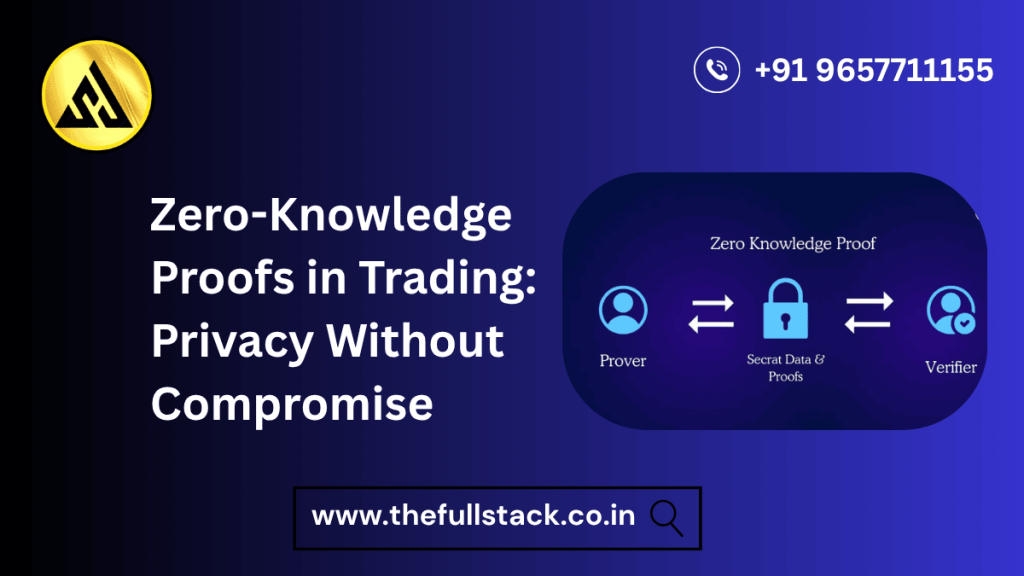
In today’s fast-paced digital markets, privacy is more than a preference—it’s a necessity. Traders want to execute transactions and validate their trades without exposing sensitive information. How can a platform confirm a trade is legitimate without revealing confidential data?
The answer lies in Zero-Knowledge Proofs (ZKPs)—a cutting-edge cryptographic method that allows verification of information without sharing the actual details. In simple terms, ZKPs let you prove that something is true without disclosing the underlying secrets.
This blog explains Zero-Knowledge Proofs in trading for beginners, including market trends, practical use cases, and tips to get started safely.
What Are Zero-Knowledge Proofs?
A Zero-Knowledge Proof is a way for one party (the prover) to demonstrate to another party (the verifier) that they know certain information without revealing the information itself.
Think of it like proving you have enough funds to make a trade without showing your full bank account. ZKPs ensure that the verifier is confident in the truth of the statement without ever accessing sensitive details.
Key benefits:
- Privacy: Protect personal and financial data.
- Security: Safeguard against hacks and data leaks.
- Trust: Confirm transactions are legitimate without sharing sensitive info.
Why Zero-Knowledge Proofs Are Critical in Trading
Trading often involves confidential information, from account balances to trading strategies. ZKPs bring several advantages:
- Protect Sensitive Data: Traders can prove eligibility to trade or fund levels without revealing actual figures.
- Secure Smart Contracts: Blockchain-based contracts can execute transactions while keeping participants’ data hidden.
- Prevent Market Manipulation: By verifying trades privately, ZKPs reduce the risk of front-running or strategy exposure.
- Ensure Compliance: Platforms can demonstrate regulatory adherence without compromising user privacy.
Market Trends & Insights
Zero-Knowledge Proofs are shaping the future of finance:
- DeFi Growth: Privacy-preserving protocols are gaining traction in decentralized finance.
- Institutional Adoption: Banks and trading firms use ZKPs for secure audits and regulatory reporting.
- Crypto Innovation: Layer-2 blockchain solutions increasingly integrate ZKPs for secure, private transactions.
Industry analysts predict that ZKPs will be a standard feature in next-generation financial platforms over the next few years.
Real-World Applications
- Private Order Validation: Exchanges can confirm trades follow rules without revealing order size or pricing strategies.
- Confidential Funding Proofs: Traders can show they have enough funds for a trade without exposing balances.
- Regulatory Compliance: Companies can prove adherence to KYC/AML rules while keeping client data private.
- Secure Smart Contracts: DeFi applications can execute trades and transactions without exposing private inputs.
Beginner-Friendly Example: Raj’s Trading Experience
Raj, a beginner trader, wants to invest in a DeFi platform but doesn’t want to reveal his account balance or trading strategy.
- Using a platform with ZKP technology, he proves he has sufficient funds for trades.
- The platform confirms all his transactions comply with rules without exposing sensitive data.
- Raj can trade confidently, knowing his financial information remains private while still verified.
This demonstrates how ZKPs make privacy and trust possible in modern trading.
Practical Tips for Beginners
- Learn Core Concepts: Understand blockchain, smart contracts, and cryptography basics.
- Start Small: Use demo accounts or minimal investments to explore ZKP-enabled platforms.
- Pick Trusted Platforms: Only trade on platforms that integrate verified ZKP technology.
- Stay Updated: Follow trends in DeFi, privacy coins, and regulatory updates.
- Analyze Logs: Observe how trades are verified without compromising privacy to learn best practices.
Challenges to Consider
- Technical Complexity: Understanding ZKPs requires some knowledge of cryptography.
- Resource Demands: ZKP computations can be resource-intensive, though innovations are improving efficiency.
- Platform Availability: Not all trading platforms currently support ZKPs, limiting accessibility.
Despite these challenges, ZKPs are rapidly becoming practical for everyday trading.
Conclusion: Trade Securely, Trade Privately
Zero-Knowledge Proofs are changing the way traders interact with digital financial platforms. They offer the unique ability to verify truth without revealing sensitive information, creating a balance between transparency and privacy.
For beginners, ZKPs are an opportunity to engage with modern, secure trading systems while building financial literacy. By learning and using this technology, traders can confidently navigate markets without compromising confidentiality.
👉 Take the next step today. Explore our courses and resources on blockchain, AI, and privacy-focused trading to gain hands-on experience. Secure, private, and transparent trading is the future—start learning now.
What is AWS Lambda?A Beginner’s Guide to Serverless Computing in 2025
Java vs. Kotlin: Which One Should You Learn for Backend Development?
Where to Find Your Salesforce Organization ID
How Salesforce Stands Out from Other CRMs
Frequently Asked Questions
What are Zero-Knowledge Proofs in trading and how do they work?
Zero-Knowledge Proofs are cryptographic techniques that enable one party to verify the validity of a transaction without revealing any sensitive information. This is achieved through complex mathematical algorithms that prove the statement is true without disclosing the underlying data. By using Zero-Knowledge Proofs, traders can maintain their privacy while still allowing for secure and trustworthy transactions.
How do Zero-Knowledge Proofs ensure privacy in trading without compromising security?
Zero-Knowledge Proofs ensure privacy by only revealing the validity of a statement, such as the authenticity of a transaction, without disclosing any additional information. This approach prevents unauthorized parties from accessing sensitive data, while still allowing for secure and trustworthy transactions to take place. As a result, traders can maintain control over their personal and financial information.
Are Zero-Knowledge Proofs widely adopted in the trading industry, and what are the benefits for traders?
Although Zero-Knowledge Proofs are not yet widely adopted in the trading industry, they have the potential to revolutionize the way traders conduct transactions. The benefits for traders include enhanced privacy, increased security, and reduced risk of fraud and identity theft. By adopting Zero-Knowledge Proofs, traders can protect their sensitive information and maintain control over their financial transactions.
Can Zero-Knowledge Proofs be used in conjunction with other security measures to further enhance trading security?
Yes, Zero-Knowledge Proofs can be used in conjunction with other security measures, such as encryption and multi-factor authentication, to further enhance trading security. By combining these technologies, traders can create a robust and secure trading environment that protects their sensitive information and prevents unauthorized access. This multi-layered approach can provide traders with an added layer of protection and peace of mind.
What are the potential challenges and limitations of implementing Zero-Knowledge Proofs in trading systems?
The implementation of Zero-Knowledge Proofs in trading systems can be complex and may require significant investment in infrastructure and expertise. Additionally, the use of Zero-Knowledge Proofs may introduce new risks, such as the potential for errors in the proof verification process, which can compromise the security of the system. As such, traders and trading platforms must carefully evaluate the benefits and challenges of implementing Zero-Knowledge Proofs in their systems.