


Hypertext Preprocessor is what PHP stands for. It is a popular open-source programming language for creating websites. Developers can construct dynamic and interactive websites by integrating PHP code into HTML. PHP is capable of handling database integration, form handling, session management, and data processing. PHP 8.4 is the most recent version, which was made available in 2024.
PHP is a server-side scripting language that works with databases, forms, and sessions while producing dynamic content on the server.
PHP facilitates simple communication with databases such as MySQL, allowing for effective data management.
PHP is compatible with well-known web servers like Apache and Nginx and runs on a variety of operating systems.
Syntax:
<?php
// PHP code goes here
?>
“Hello, World!” Program
A “Hello, World!” program is the simplest way to get started with any programming language. Here’s how you can write one using PHP.
<?php
echo “Hello, World!”;
?>
Output
Hello, World!
In this example
- <?php and ?> are the PHP tags used to embed PHP code into an HTML document.
- echo is a PHP function used to output text to the browser.
- “Hello, World!” is the text that will be displayed when the PHP code is executed.
How PHP Works?
Below are the following steps, which shows how the PHP works:

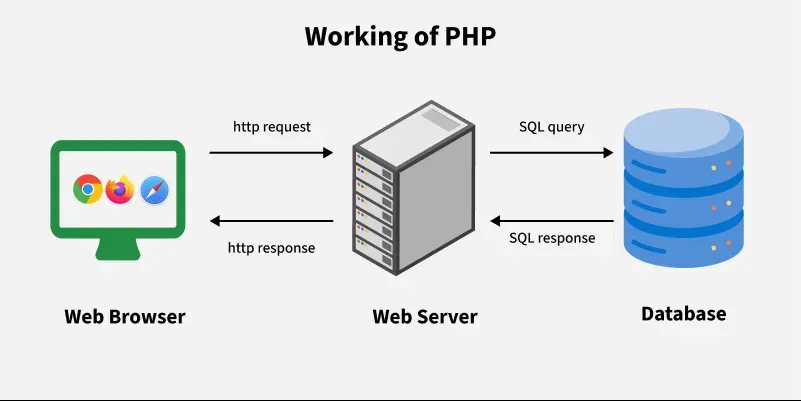
Working of PHP
Step 1: User Requests the Page
- The user enters a URL into a web browser or clicks on a link, making an HTTP request to the web server.
Step 2: Web Server Receives the Request
- The web server (Apache, Nginx, etc.) receives the HTTP request. The request is directed to PHP for processing.
- The PHP script located on the server is executed.
Step 3: PHP Processes the Request
- The PHP script processes any server-side logic, such as handling form submissions, processing data, or making requests to a database.
- If the PHP script requires database interaction, an SQL query is sent to the database.
Step 4: Database Interaction
- The PHP script uses a SQL query to submit a request to the database (such as MySQL).
- The PHP script receives a response (the query’s results) from the database after it has processed the query.
Step 5: PHP Responds with Dynamic Content
- The PHP script prepares and processes the output (dynamic HTML or other material) that will be returned to the user’s browser based on the database response.
- The web browser receives this response as an HTTP response.
Step 6: Web Browser Receives the Response
- The web browser receives the HTTP response, which includes dynamic content generated by PHP.
- The browser renders the content on the user’s screen.
This is how the PHP workflow operates in web applications, where PHP interacts with a database and a web server to generate dynamic content for the user.
PHP is a Loosely Typed Language
Since PHP is regarded as a weakly typed language, you can declare variables without specifying the data type. Depending on the value that is assigned to the variable at runtime, PHP will automatically determine its type..
- In PHP 7, type declarations was introduced.
- This allows developers to define the expected data type for function parameters.
- By enabling strict typing, PHP will raise a “Fatal Error” if the passed argument does not match the declared type.
- PHP dynamically assigns a data type to a variable based on the value it holds. Since the language is not strongly typed, operations like adding a string to an integer can be performed without causing an error.
Now, let us understand with the help of the example:
Without Using Strict Mode
In this example the strict mode is not enabled so it will change string “3” to int 3 and it will return result 8.
<?php
function addNumbers(int $a, int $b) {
return $a + $b;
}
echo addNumbers(5, “3”);
?>
Output
8
Using Strict Mode
In this the strict mode is enabled so “3” is not an integer it is string so the error will be thrown.
<?php
declare(strict_types=1); // Strict mode enabled
function addNumbers(int $a, int $b) {
return $a + $b;
}
echo addNumbers(5, “3”); // Throws Fatal Error: Uncaught TypeError: Argument 2 passed to addNumbers
?>
Output
Fatal error: Uncaught TypeError: Argument 2 passed to addNumbers() must be of the type int, string given, called in /home/guest/sandbox/Solution.php on line 8 and defined in /home/guest/sandbox/Solut…
Key Features of PHP
- PHP has the ability to create dynamic HTML that is supplied to the browser using client-side scripting. The material it produces can be viewed in the client’s browser while it is operating on the server.
- Database Handling: PHP facilitates effective data administration and storage in online applications by connecting to databases such as MySQL, PostgreSQL, and SQLite.
- Easy Learning Curve: PHP’s syntax is simple to understand, particularly for people who are familiar with HTML and programming principles.
- Rich Ecosystem: PHP provides a wealth of frameworks and libraries, such as Laravel and Symfony, that speed up and improve development.
- Scalability: PHP’s strong scalability enables programmers to build websites that may expand in terms of functionality and traffic.
PHP in Web Development
PHP is most commonly used for web development. It can handle tasks like:
- Processing form submissions
- Handling user authentication and sessions
- Generating dynamic web content
- Managing databases and user data
- Handling APIs and requests
Applications of PHP
- Web Development: PHP is widely used for creating dynamic websites and web applications by generating interactive content, handling user inputs, and interacting with databases.
- Command-Line Scripting: PHP can be used to write command-line scripts for automating repetitive tasks, such as data processing or system monitoring.
- Game Development: PHP is used for backend logic in browser-based multiplayer games, handling user authentication, scores, and game state.
- Real-Time Applications: PHP supports real-time applications like chat systems and live updates, typically using AJAX or WebSockets.
- File Management: PHP handles file uploads and creates file management systems for organizing and downloading files.
Limitations of PHP
- Security Risks: PHP is susceptible to attacks like SQL injection, XSS, and CSRF if it is not utilized correctly. Developers are required to adhere to security best practices.
- Not the Best for Command-Line: Although PHP may be executed from the command line, its performance for general-purpose operations may not be as good as that of other languages because it is primarily intended for web development.
- Limited Support for Multi-Threading: PHP has less support for multi-threading than languages like Java or Node.js, despite being able to manage concurrent requests from asynchronous frameworks.
Why is PHP still popular?
- Widely Supported: PHP is supported by most web hosting services, making it easy to deploy PHP-based websites and applications.
- Constant Evolution: With regular updates and new features in PHP 7 and PHP 8, PHP continues to improve in terms of performance, security, and functionality.
- Huge Community: The PHP community is large and active, providing extensive documentation, libraries, and frameworks to ease development.
You also like this:-
Introduction to Serverless Databases: Firebase, AWS DynamoDB, & More
Where to Find Your Salesforce Organization ID
Frequently Asked Questions
What is PHP and how is it used?
PHP is a server-side scripting language used for web development, allowing developers to create dynamic and interactive web pages. It is commonly used for building websites, web applications, and content management systems. PHP can be embedded into HTML to create dynamic content and interact with databases.
Do I need to know HTML and CSS to learn PHP?
While it is possible to learn PHP without prior knowledge of HTML and CSS, having a basic understanding of these technologies can be beneficial. HTML and CSS are used for structuring and styling web pages, and PHP is often used in conjunction with these technologies to create dynamic web content. Knowing the basics of HTML and CSS can help you understand how PHP fits into the web development process.
What are the benefits of using PHP for web development?
PHP offers several benefits for web development, including its open-source nature, ease of use, and flexibility. PHP can be used on a variety of operating systems and web servers, making it a popular choice for developers. Additionally, PHP has a large community of developers who contribute to its growth and provide support, making it a reliable choice for web development projects.
How do I get started with learning PHP?
To get started with learning PHP, you can begin by installing a local development environment on your computer, such as XAMPP or WAMP. You can then start learning the basics of PHP, including variables, data types, and control structures, through online tutorials or coding courses. Practice is key to learning PHP, so be sure to start building small projects and experimenting with different coding techniques.
Are there any security concerns I should be aware of when using PHP?
Yes, as with any programming language, there are security concerns to be aware of when using PHP. PHP scripts can be vulnerable to attacks such as SQL injection and cross-site scripting (XSS), so it is essential to follow best practices for secure coding and use prepared statements to prevent these types of attacks. Additionally, keeping your PHP version and extensions up to date can help prevent security vulnerabilities.