


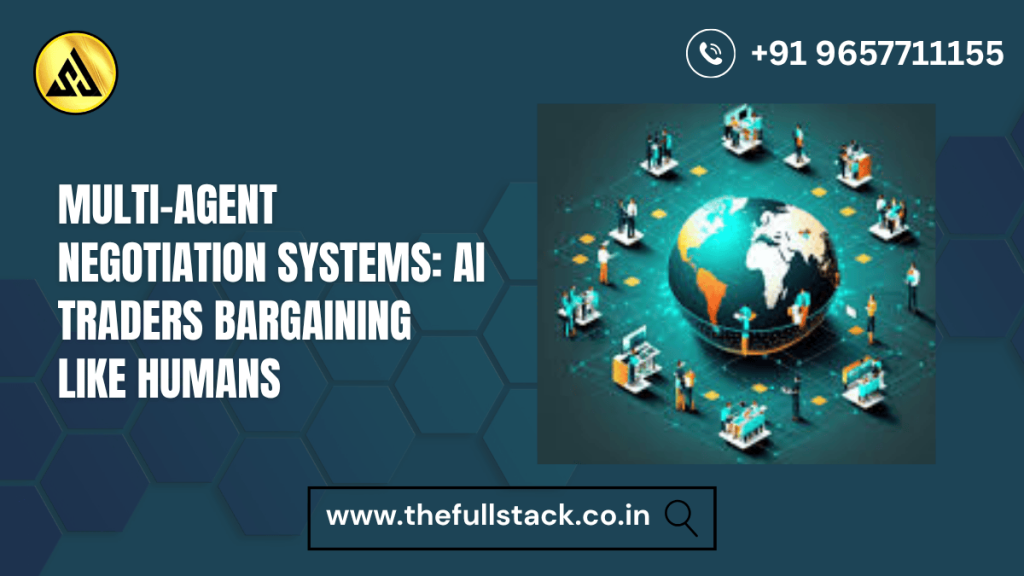
Imagine a stock market where AI agents negotiate prices, strategize trades, and make split-second decisions — just like human traders. This isn’t science fiction anymore; it’s the new reality powered by Multi-Agent Negotiation Systems (MANS).
In today’s fast-paced financial markets, the ability to negotiate, adapt, and predict outcomes determines who leads and who lags. With multi-agent systems, artificial intelligence is now learning to bargain, cooperate, and compete like humans — but faster and more efficiently.
If you’re new to this concept, don’t worry. By the end of this article, you’ll understand what multi-agent negotiation systems are, how they’re transforming trading, and how you can start learning about them to stay ahead in the future of finance.
1. What Are Multi-Agent Negotiation Systems?
At its core, a Multi-Agent Negotiation System (MANS) is a network of AI agents that interact to achieve goals, often through negotiation and communication. Each agent operates autonomously, representing different entities — for example, investors, brokers, or institutions — and engages in strategic discussions to reach mutually beneficial outcomes.
In trading, these agents simulate human-like decision-making:
- Buyers aim for lower prices.
- Sellers aim for higher profits.
- Market agents balance supply and demand.
The fascinating part? They learn from experience, adapting negotiation strategies just like a seasoned trader would after years in the market.
2. The Human-Inspired Approach: AI That Bargains
Traditional algorithms execute trades based on predefined rules. But MANS go beyond that — they negotiate.
They use advanced AI models such as reinforcement learning and game theory to:
- Analyze the intent of other agents.
- Predict likely responses.
- Adjust offers dynamically in real-time.
Think of it as a digital marketplace where AI agents discuss prices, compare offers, and make deals. Each agent has its own strategy, communication protocol, and risk tolerance — just like human traders bargaining over the best deal.
3. Why Are Negotiation Systems Important in Trading?
The stock and crypto markets are complex ecosystems where thousands of participants interact simultaneously. Traditional automation struggles with the ambiguity of human negotiation, but AI-driven systems excel at it.
Here’s why this matters:
- Speed and Precision – AI agents can evaluate thousands of negotiation possibilities in milliseconds.
- Emotion-Free Decisions – Unlike humans, AI agents don’t panic during volatility.
- Scalable Intelligence – Multiple agents can negotiate across various assets, times, and geographies simultaneously.
- Continuous Learning – The system evolves as it learns from past negotiations, improving with each interaction.
In simple terms, AI negotiation systems mimic the emotional intelligence of humans but operate at machine speed.
4. Real-World Applications of Multi-Agent Negotiation
These systems aren’t just theoretical — they’re being implemented across multiple industries, including:
a. Stock and Crypto Trading
AI agents act as virtual traders, negotiating trade terms, optimizing portfolios, and predicting market shifts. This allows firms to react faster to real-time changes while reducing manual intervention.
b. Supply Chain and Logistics
Negotiation systems are used for dynamic pricing, vendor contracts, and demand forecasting. Agents representing suppliers, manufacturers, and retailers negotiate to balance profit margins and delivery timelines.
c. Energy Markets
In smart grids, agents negotiate energy prices and resource allocations between consumers and suppliers, ensuring efficiency and cost reduction.
d. Financial Institutions
Banks and investment platforms are exploring MANS to personalize investment strategies, handle client negotiations, and manage automated deal-making.
5. How Does AI Learn to Negotiate?
The secret lies in Reinforcement Learning (RL) — a machine learning technique where AI agents learn through trial and error.
Imagine teaching a new trader how to bargain:
- If they make a good deal, they get rewarded.
- If they lose value, they adjust next time.
AI agents go through millions of such “negotiation simulations,” continually refining their strategy. Over time, they develop negotiation intelligence, understanding how to balance cooperation and competition to maximize gains.
6. Industry Trends: The Future of AI Negotiation in Markets
The global financial sector is rapidly adopting AI-based negotiation and trading systems. According to market reports, automated negotiation platforms are projected to grow by over 35% annually in the next five years.
Key trends to watch include:
- Decentralized AI Markets: Agents operating autonomously on blockchain networks.
- Hybrid Human-AI Teams: Human traders collaborating with AI negotiators.
- Ethical AI in Finance: Ensuring fairness, transparency, and accountability in automated negotiations.
Soon, we’ll see AI-driven marketplaces where intelligent agents represent both individuals and corporations — making deals, managing portfolios, and executing trades 24/7.
7. Practical Example: AI Traders in Action
Let’s simplify this with an example:
Suppose two AI agents — one representing an investor and the other representing a brokerage — are negotiating the purchase of 1,000 shares.
- The Investor Agent wants to buy at ₹980 per share.
- The Broker Agent wants to sell at ₹1,000 per share.
- Both agents analyze current trends, liquidity, and market volatility.
Through iterative negotiation, they settle at ₹990, completing a mutually beneficial trade — all without human input.
This is how multi-agent negotiation brings efficiency and precision to trading while maintaining the essence of human-like bargaining.
8. Benefits for Businesses and Traders
By integrating MANS, companies and traders gain:
✅ Higher Efficiency: Automated deal-making reduces manual delays.
✅ Cost Savings: AI-driven negotiations eliminate overpricing or underselling.
✅ Better Insights: Data from negotiations helps refine future strategies.
✅ Scalability: Multiple negotiations can occur simultaneously.
✅ Predictive Accuracy: AI forecasts negotiation outcomes with precision.
In essence, these systems replicate the intuition of experienced negotiators, giving traders a smarter, data-driven advantage.
9. How to Get Started with AI Negotiation Systems
If this topic excites you, here’s how you can begin your journey:
- Learn the Basics of AI & Machine Learning: Familiarize yourself with core concepts like reinforcement learning, natural language processing, and game theory.
- Explore Trading Automation Tools: Platforms like Salesforce, MetaTrader, or Python-based APIs can be your playground.
- Join AI and Finance Courses: Many institutes (including ours!) offer practical, beginner-friendly programs combining AI, data analytics, and trading.
- Experiment with Simulations: Start small — use virtual trading environments to test your strategies safely.
Remember, the future belongs to those who learn, adapt, and innovate early.
10. Conclusion: The Future of AI Negotiation Has Arrived
Multi-Agent Negotiation Systems represent the next leap in financial technology — where machines not only think but negotiate like humans.
As markets evolve, traders and businesses that embrace these technologies will gain a competitive edge — mastering both strategy and automation.
So whether you’re an investor, student, or professional, now is the time to explore how AI-driven negotiation systems can transform your financial future.
💡 Start your journey today — explore our AI and Trading courses designed to help you master automation and stay future-ready in the digital economy.

What is AWS Lambda?A Beginner’s Guide to Serverless Computing in 2025

Java vs. Kotlin: Which One Should You Learn for Backend Development?
Where to Find Your Salesforce Organization ID
How Salesforce Stands Out from Other CRMs
Frequently Asked Questions
What is a Multi-Agent Negotiation System?
A Multi-Agent Negotiation System is a type of artificial intelligence that enables multiple agents to negotiate and make decisions like humans. These systems are designed to simulate human-like bargaining and can be used in various applications, such as e-commerce and supply chain management. They help to create more efficient and effective negotiation processes.
How do AI traders learn to bargain like humans?
AI traders learn to bargain like humans through machine learning algorithms that enable them to analyze and adapt to different negotiation scenarios. They can learn from data and improve their negotiation strategies over time, allowing them to make more effective decisions. This process helps to create more realistic and human-like negotiation interactions.
What are the benefits of using Multi-Agent Negotiation Systems?
The benefits of using Multi-Agent Negotiation Systems include increased efficiency, improved decision-making, and enhanced negotiation outcomes. These systems can also help to reduce costs and improve relationships between parties by enabling more effective communication and collaboration. Additionally, they can provide valuable insights into negotiation dynamics and behaviors.
Can Multi-Agent Negotiation Systems be used in real-world applications?
Yes, Multi-Agent Negotiation Systems can be used in real-world applications, such as online marketplaces, supply chain management, and financial trading. They can help to automate and optimize negotiation processes, reducing the need for human intervention and improving overall performance. These systems can also be used to analyze and simulate different negotiation scenarios, allowing for more informed decision-making.
How do Multi-Agent Negotiation Systems handle conflicts and disagreements?
Multi-Agent Negotiation Systems can handle conflicts and disagreements by using advanced algorithms and strategies that enable agents to adapt to changing negotiation dynamics. These systems can also incorporate mechanisms for resolving disputes and reaching mutually beneficial agreements, such as mediation and arbitration. Additionally, they can provide tools for analyzing and understanding the underlying causes of conflicts, allowing for more effective conflict resolution.