
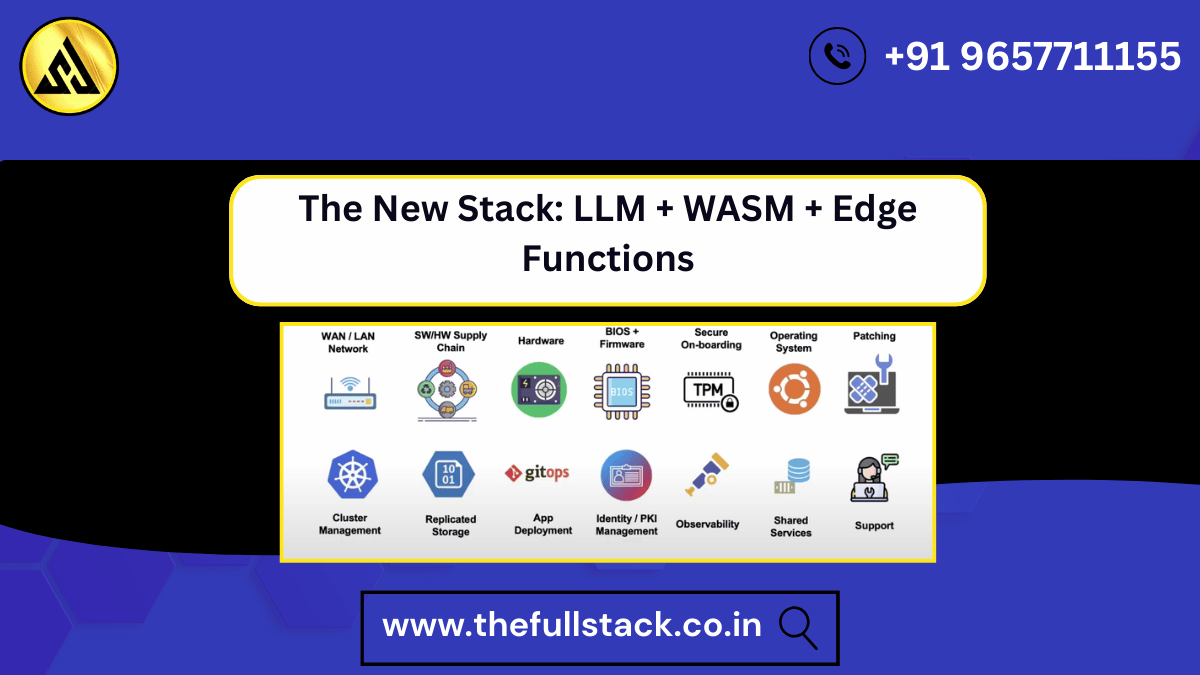
The New Stack: LLM + WASM + Edge Functions
The way we build applications is changing faster than ever. Traditional backend-heavy architectures are struggling to meet modern demands like real-time intelligence, global performance, and cost efficiency. As a result, a new technology stack is emerging—one that combines Large Language Models (LLMs), WebAssembly (WASM), and Edge Functions.
For beginners and professionals alike, this stack may sound complex. But when broken down, it represents a natural evolution toward faster, smarter, and more scalable software.
In this guide, we’ll explore the LLM WASM Edge Functions stack in simple terms, explain why it matters, and show how companies are already using it today.
Why a New Stack Was Needed
Traditional cloud architectures rely on centralized servers located far from users. While this worked for years, modern applications now demand:
- Instant responses
- Personalized AI-driven experiences
- Global availability
- Lower infrastructure costs
Sending every request to a distant cloud server adds latency and limits scalability. The new stack solves this by bringing intelligence closer to users.
Understanding the Three Core Technologies
To understand the new stack, let’s break it into its three building blocks.
What Are Large Language Models (LLMs)?
Large Language Models are AI systems trained on massive amounts of text to understand and generate human-like language.
Examples include:
- Chatbots
- Code assistants
- Search summarization tools
- Recommendation systems
LLMs allow applications to reason, respond, and personalize experiences instead of relying on static logic.
What Is WebAssembly (WASM)?
WebAssembly is a low-level binary format that allows code written in languages like C, C++, Rust, and Go to run at near-native speed in browsers and servers.
Key benefits of WASM:
- High performance
- Language flexibility
- Strong security sandbox
- Cross-platform compatibility
WASM acts as a universal runtime for modern applications.
What Are Edge Functions?
Edge functions are lightweight functions that run on servers located close to users, instead of a centralized data center.
They allow developers to:
- Process requests instantly
- Reduce latency
- Scale automatically
- Lower bandwidth costs
Edge functions are a core part of edge computing.
Why LLM WASM Edge Functions Work So Well Together
Individually, each technology is powerful. Together, they form a revolutionary stack.
Here’s how they complement each other:
- LLMs provide intelligence
- WASM provides speed and portability
- Edge functions provide proximity and scalability
This combination allows AI-powered logic to run closer to users, instead of deep inside cloud infrastructure.
A Real-World Example
Imagine an e-commerce website with AI-powered product recommendations.
Traditional approach:
- User request goes to central server
- Server calls AI service
- Response returns after multiple network hops
New stack approach:
- Edge function receives the request
- WASM module executes logic instantly
- LLM generates personalized results at the edge
The result is a faster, smarter shopping experience.
Performance Advantages of the New Stack
Performance is one of the biggest reasons companies adopt the LLM WASM Edge Functions stack.
Key improvements include:
- Reduced latency
- Faster AI inference
- Lower cold-start times
- Efficient resource usage
Users experience near-instant responses, even on global applications.
Cost Efficiency and Scalability
Running everything in the cloud can be expensive. Edge-based architectures reduce costs by:
- Minimizing data transfer
- Running lightweight workloads
- Scaling only when needed
WASM’s efficiency means fewer resources are required to deliver high performance.
Security Benefits
Security is built into this stack by design.
WASM provides:
- Memory safety
- Sandboxed execution
- Limited system access
Edge functions reduce attack surfaces by limiting centralized infrastructure exposure.
Industry Trends Driving Adoption
Several industry trends are accelerating adoption of this new stack.
AI Everywhere
Companies are embedding AI into every product, not just standalone tools. LLMs at the edge make AI faster and more contextual.
Serverless and Edge-First Architectures
Organizations are moving away from monolithic backends toward distributed, serverless systems.
Multi-Language Development
WASM allows teams to write logic in multiple languages while deploying everywhere.
Common Use Cases Today
The LLM WASM Edge Functions stack is already being used in production.
Popular use cases include:
- AI chatbots at the edge
- Smart search and filtering
- Real-time content moderation
- Personalized recommendations
- Intelligent API gateways
These applications benefit from speed, intelligence, and scalability.
How Beginners Can Start Learning This Stack
For beginners, the best way to approach this stack is step by step.
Start with:
- Understanding edge computing basics
- Learning WASM fundamentals
- Exploring how LLM APIs work
- Combining them in small projects
This layered learning approach makes the stack approachable.
Challenges and Considerations
While powerful, this stack is not without challenges.
Common considerations include:
- Model size limitations at the edge
- Observability and debugging
- Security configuration
- Vendor ecosystem differences
Understanding these early helps teams design better solutions.
The Future of LLM WASM Edge Functions
The future looks promising.
We can expect:
- Smaller, faster AI models
- Better WASM tooling
- Deeper edge platform integration
- AI-native edge platforms
This stack is becoming the foundation for next-generation applications.
Final Thoughts
The LLM WASM Edge Functions stack represents a major shift in how software is built and deployed.
By combining intelligence, performance, and proximity, it enables:
- Faster applications
- Smarter user experiences
- More scalable systems
For beginners and professionals alike, understanding this new stack is a valuable investment in the future of technology.
Call to Action
Ready to build next-generation applications?
Explore edge computing tutorials, WASM development courses, and AI integration guides to start mastering the LLM WASM Edge Functions stack today and stay ahead in your tech career.
Start your journey with Unified Cloud Environments today. Your future development productivity begins in the cloud.
What is AWS Lambda?A Beginner’s Guide to Serverless Computing in 2025
Java vs. Kotlin: Which One Should You Learn for Backend Development?

Leave a Reply