


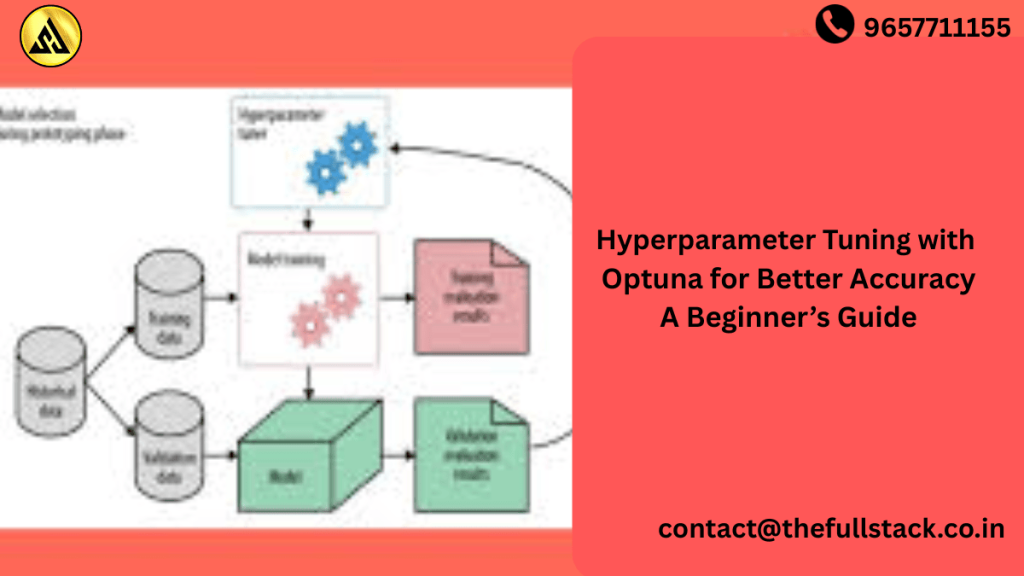
That’s where hyperparameter tuning comes in. And today, one of the most exciting tools leading the way is Optuna.
Whether you’re a student, a business professional, or just someone curious about how AI delivers smarter predictions, this guide will help you understand the fundamentals of hyperparameter tuning, why Optuna is a game-changer, and how you can apply it in real-world scenarios.
What Are Hyperparameters, Anyway?
Before diving into Optuna, let’s clear up what hyperparameters are.
- Parameters are learned by the model during training (e.g., weights in a neural network).
- Hyperparameters are set before training and guide how the model learns (e.g., learning rate, number of trees in XGBoost, depth of a neural network).
Choosing the right hyperparameters is critical. Too high a learning rate? The model overshoots patterns. Too low? It learns painfully slow. Wrong settings for tree depth? Overfitting or underfitting creeps in.
Hyperparameter tuning is all about finding that sweet spot where the model performs at its best.
Why Traditional Tuning Falls Short
For years, data scientists relied on methods like:
- Grid Search: Testing every combination (effective but slow).
- Random Search: Trying random combinations (faster, but often misses the best results).
Both methods are time-consuming and resource-heavy, especially when dealing with complex models and large datasets.
This is where Optuna steps in with a smarter approach.
Introducing Optuna: The Smart Tuner
Optuna is an open-source framework designed to automate hyperparameter optimization. Instead of testing blindly, Optuna uses Bayesian optimization and pruning techniques to zero in on the best parameters efficiently.
Why Optuna stands out:
- Automation: Saves hours of manual trial-and-error.
- Efficiency: Finds better hyperparameters with fewer trials.
- Flexibility: Works with popular ML libraries like TensorFlow, PyTorch, XGBoost, and LightGBM.
- Visualization Tools: Offers charts to understand how parameters affect accuracy.
Think of Optuna as your personal assistant—constantly adjusting, learning, and improving your model’s performance while you focus on the bigger picture.
Real-World Applications of Optuna
Optuna isn’t just for academic projects—it’s transforming industries:
- Finance & Stock Predictions
Traders use Optuna to fine-tune models predicting market movements, achieving faster and more accurate results. - Healthcare Diagnostics
Hospitals use ML models tuned with Optuna to improve disease detection accuracy, supporting doctors in early diagnosis. - Retail & E-commerce
Companies optimize recommendation engines to provide more personalized shopping experiences. - Manufacturing & IoT
Predictive maintenance models tuned with Optuna reduce downtime and improve equipment performance.
Relatable Example: Tuning XGBoost with Optuna
Let’s say you’re predicting whether a stock will go up or down. You decide to use XGBoost. The performance depends heavily on hyperparameters like max_depth, learning_rate, and n_estimators.
Without tuning, your accuracy might hover around 65%. With Optuna, you could push that accuracy closer to 75–80%, just by letting the framework find better values for these hyperparameters.
This difference can mean thousands of dollars gained or saved in real-world financial decisions.
Market Trends & Industry Insights
The rise of automated hyperparameter tuning mirrors a broader trend in AI adoption:
- 85% of enterprises now view AI as critical to competitiveness.
- Automated ML (AutoML) tools, including Optuna, are projected to grow rapidly as businesses seek speed and efficiency.
- Data literacy is becoming an essential skill, not just for data scientists but for employees across all departments.
For employees, learning tools like Optuna is more than just technical training—it’s an investment in career growth and staying relevant in an AI-powered world.
Practical Tips for Beginners
If you’re new to Optuna, here’s how to get started:
- Install Optuna Easily: Run pip install optuna.
- Start Small: Use it on simple models before moving to advanced neural networks.
- Define Objectives Clearly: Decide whether you’re optimizing for accuracy, precision, or speed.
- Use Visualization: Optuna provides easy-to-read graphs showing which parameters matter most.
- Combine with AutoML: Pair Optuna with frameworks like LightGBM or PyTorch for faster experimentation.
Motivational Takeaway
Hyperparameter tuning might sound technical, but here’s the truth: it’s a skill anyone can learn with the right guidance.
Think of it as cooking—hyperparameters are your ingredients, and Optuna is the recipe optimizer helping you get the perfect dish every time.
By learning Optuna, you’re not just improving models—you’re opening doors to smarter business decisions, better predictions, and ultimately, greater success.
Final Thoughts
Hyperparameter tuning with Optuna is one of the most powerful ways to unlock the true potential of machine learning models. From predicting stock prices to improving healthcare diagnostics, Optuna’s flexibility and efficiency make it a must-have skill in today’s data-driven world.
🚀 Ready to take the next step? Explore our advanced machine learning courses to gain hands-on experience with Optuna and other cutting-edge tools. Visit our website today and start building a future-ready career in AI and finance.
What is AWS Lambda?A Beginner’s Guide to Serverless Computing in 2025
Java vs. Kotlin: Which One Should You Learn for Backend Development?
Where to Find Your Salesforce Organization ID
How Salesforce Stands Out from Other CRMsv
Frequently Asked Questions
What is hyperparameter tuning and why is it important?
Hyperparameter tuning is the process of adjusting the parameters of a machine learning model to achieve better performance and accuracy. It is important because the default parameters may not be optimal for a specific problem, and tuning them can significantly improve the model’s performance. By using Optuna, you can automate this process and find the best combination of parameters for your model.
How does Optuna work for hyperparameter tuning?
Optuna is a Bayesian optimization framework that uses a tree-structured Parzen estimator to search for the optimal hyperparameters. It works by iteratively sampling the hyperparameter space, evaluating the model’s performance, and using the results to guide the search towards the most promising areas. This approach allows Optuna to efficiently explore the hyperparameter space and find the best combination of parameters.
What are the benefits of using Optuna for hyperparameter tuning?
Using Optuna for hyperparameter tuning offers several benefits, including improved model accuracy, reduced tuning time, and increased efficiency. Optuna’s automated tuning process saves time and effort compared to manual tuning, and its Bayesian optimization approach is more effective than traditional grid search or random search methods. Additionally, Optuna provides a simple and intuitive interface for defining the hyperparameter search space and monitoring the tuning process.
Can I use Optuna with any machine learning framework?
Yes, Optuna is designed to be framework-agnostic, meaning it can be used with any machine learning framework, including scikit-learn, TensorFlow, PyTorch, and others. Optuna provides a simple and flexible interface for integrating with your existing machine learning workflow, allowing you to use its hyperparameter tuning capabilities with your preferred framework and tools. This makes it easy to incorporate Optuna into your existing projects and workflows.
How do I get started with using Optuna for hyperparameter tuning?
To get started with using Optuna for hyperparameter tuning, you can install the Optuna library using pip, then import it into your Python script or notebook. Next, define your objective function, which is the function that Optuna will use to evaluate the model’s performance, and specify the hyperparameter search space using Optuna’s API. Finally, run the Optuna optimization process and monitor the results to find the best combination of hyperparameters for your model.