
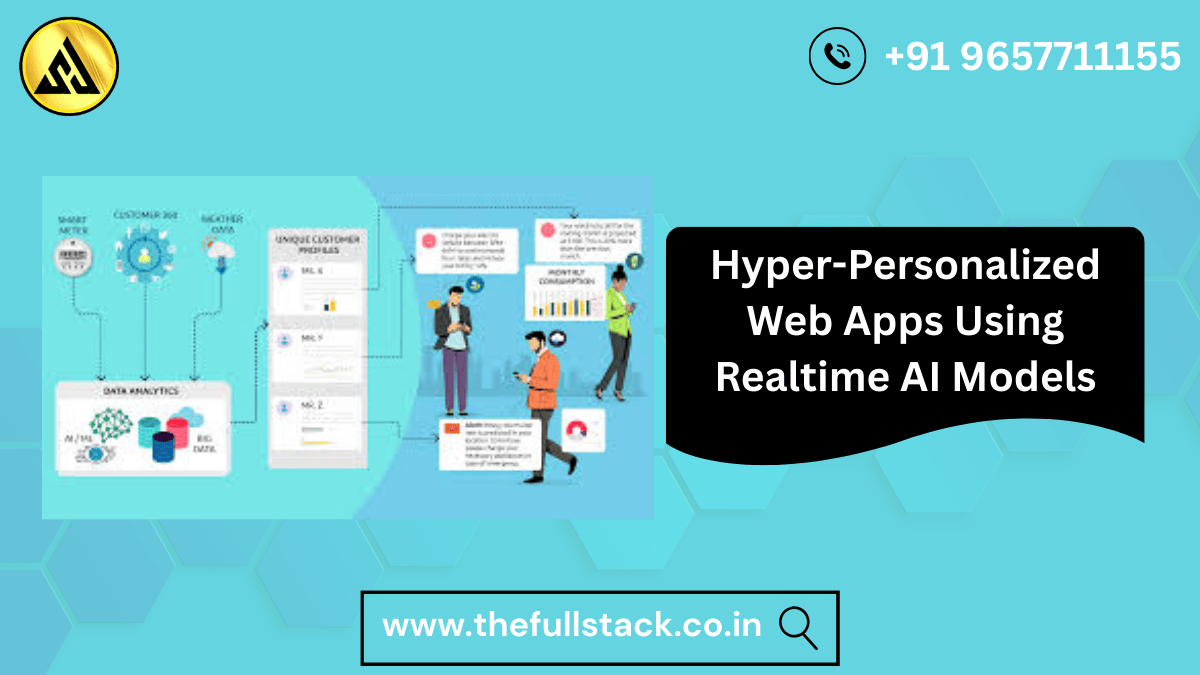
Hyper-Personalized Web Apps Using Realtime AI Models
Personalization isn’t new—but the way we personalize digital experiences today is undergoing a massive revolution. Instead of generic interfaces or static recommendation engines, businesses are now turning to Hyper-Personalized Web Apps, powered by Realtime AI Models, to deliver user experiences that adapt instantly, intelligently, and continuously.
From content recommendations to UI customization, realtime AI has unlocked the ability to tailor web applications at the level of individual users. Whether you’re a beginner learning how AI influences front-end and back-end workflows, or a company employee exploring modern customer experience strategies, this guide will walk you through everything you need to know.
What Are Hyper-Personalized Web Apps?
Hyper-personalized web apps are digital applications that change their behavior, interface, content, and recommendations instantly based on a user’s:
- Actions
- Preferences
- Context
- Behavioral patterns
- Real-time events
- Past data
Instead of showing the same layout or content to everyone, these apps reshape themselves for every user session—almost like a digital product that knows you personally.
Why This Matters Today
User expectations have changed. People demand:
- Faster results
- Relevant content
- Smarter navigation
- Predictive recommendations
- Seamless user journeys
Hyper-personalized web apps meet these expectations by using realtime AI models to process inputs instantly and adjust outputs accordingly.
What Are Realtime AI Models?
Realtime AI models are AI systems capable of:
- Processing data instantly
- Generating responses within milliseconds
- Adapting continuously
- Updating decisions as user behavior changes
Think of them as “always-on intelligence”—AI models that power an app the same way your brain processes live information.
Examples include:
- Recommender systems
- Prediction engines
- Generative models
- Behavioral analytics models
- Personalized LLM responses
- Adaptive UI decision models
These models can be embedded directly into your web app or accessed through cloud-based APIs.
How Realtime AI Models Power Hyper-Personalization
Let’s break down how the magic happens behind the scenes.
1. User Behavior Tracking
Realtime AI agents observe actions such as:
- Clicks
- Page scrolls
- Time spent
- Navigation patterns
- Interest signals
This behavior is transformed into actionable insights within seconds.
Example:
If a user continuously checks pricing, the AI shifts the interface to highlight offers, plans, and benefits.
2. Contextual Understanding
AI models understand context like:
- Device
- Location
- Time of day
- User segment
- Current mood (using sentiment analysis)
This lets the app deliver smarter responses.
3. Instant Personalization
The interface can instantly adapt:
- Themes
- Layouts
- Product recommendations
- Content placement
- Navigation flow
The experience becomes unique to each user.
4. Predictive Intelligence
Realtime models can predict:
- What the user wants next
- What content suits them
- Which product they’re likely to buy
- When they may drop off
This avoids friction and boosts engagement.
Real-World Examples of Hyper-Personalized Web Apps
1. E-commerce
AI-powered shops show:
- Personalized product listings
- Dynamic pricing
- Tailored pop-ups
- Predictive search
Amazon and Flipkart already use realtime AI for these features.
2. EdTech
Learning platforms deliver:
- Customized lesson paths
- Difficulty adjustment
- Real-time feedback
- Hyper-personalized dashboards
This makes learning more effective and engaging.
3. Fitness Apps
AI tailors workouts based on:
- User performance
- Goals
- Fatigue detection
- Real-time corrections
Realtime recommendation engines adapt plans instantly.
4. Streaming Platforms
Netflix-style personalization includes:
- Tailored watchlists
- Personalized thumbnails
- Behavior-based recommendations
Each user receives a unique home screen.
5. Finance and Banking
AI tailors:
- Spending insights
- Loan suggestions
- Investment advice
- Fraud alerts
Everything is optimized based on real-time financial behavior.
How Developers Build Hyper-Personalized Web Apps
For beginners, here’s a simple breakdown of the building blocks.
Step 1: Capture User Data
Through:
- Events
- Sessions
- Clickstreams
- Form inputs
- API logs
Step 2: Process with Realtime AI
Developers use:
- LLM APIs
- Vector databases
- Analytics pipelines
- Cloud AI services
- On-device AI models
Step 3: Generate Personalized Response
This could be:
- A personalized product list
- A tailored learning plan
- A custom UI theme
- A predictive suggestion
Step 4: Render Instantly in the Interface
Front-end frameworks like:
- React
- Vue
- Angular
- Svelte
Dynamically update UI components in real time.
Tools and Technologies Powering Hyper-Personalization
To build modern, AI-driven personalized apps, developers commonly use:
AI Models
- OpenAI Realtime Models
- Google Gemini
- Meta LLaMA
- AWS Bedrock Models
- Custom fine-tuned models
Frameworks
- Next.js
- React Server Components
- FastAPI
- Node.js
Databases
- MongoDB
- Postgres
- Pinecone (vector database)
- Redis
Analytics & Personalization Engines
- Segment
- Mixpanel
- Clerk / Auth0
- LangChain / LlamaIndex
Each of these tools helps developers create adaptive, AI-responsive user experiences.
Industry Trends in Hyper-Personalization (2025–2030)
Future web apps will be:
- Emotion-aware using sentiment analysis
- Intent-driven using live LLM reasoning
- Multi-agent powered for dynamic workflows
- Real-time contextual with sensors and data streams
- Fully generative with AI building layout variations
- Voice-first and multimodal for natural interaction
- Self-optimizing using automated A/B testing models
The next generation of apps won’t just respond—they will predict, adapt, and evolve.
Why Businesses Should Adopt Hyper-Personalized Web Apps
Higher Conversions
Users buy more when content matches their needs.
Better Engagement
Personalized apps keep users active longer.
Stronger Customer Loyalty
Users feel understood and valued.
Reduced Churn
Predictive AI identifies and prevents drop-offs.
Smarter Decision-Making
Realtime insights help teams optimize experiences without guesswork.
Hyper-personalization isn’t optional anymore—it’s the new competitive edge.
Conclusion
Hyper-personalized web apps powered by realtime AI models are redefining what it means to deliver an exceptional digital experience. Whether you’re a beginner stepping into AI-powered development or a company employee exploring modern product strategies, the future of user experience lies in instant responsiveness, intelligent adaptations, and continuous personalization.
If you’re ready to build the next generation of smart, adaptive web apps, start learning AI-driven development today.
CTA:
Want to master AI-powered development? Explore our tutorials, join our learning community, or enroll in hands-on courses designed to help you build hyper-personalized web apps with ease.
You may be interested in this:-
Algorithms In Java: List, Programs, Interview Questions-2024

Leave a Reply