
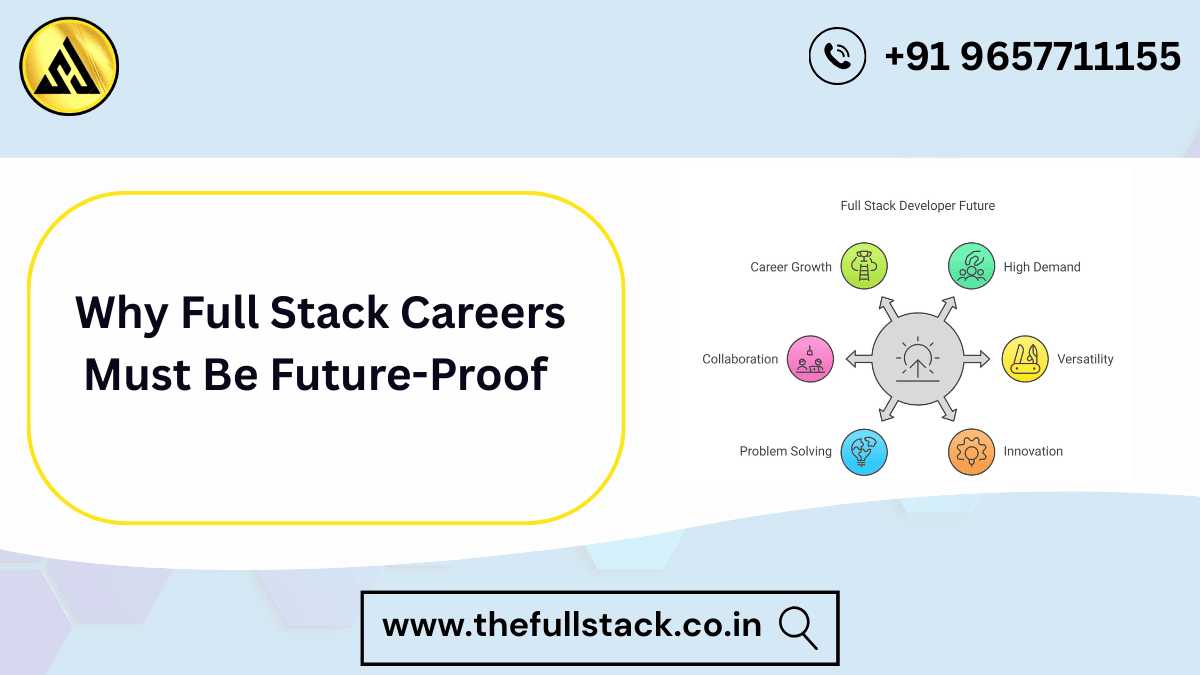
Why Full Stack Careers Must Be Future-Proof
The technology industry is changing faster than ever. Skills that were in high demand just a few years ago are already becoming outdated. For developers, especially full stack engineers, staying relevant is no longer optional—it’s essential.
This is where future-proof full stack career paths for 2026 come into focus. Companies are not just hiring coders anymore. They want engineers who understand systems, automation, AI, cloud platforms, and scalable architectures.
In this guide, we’ll explore what it means to future-proof your full stack career, which paths are emerging, and how beginners and working professionals can prepare for 2026 and beyond.
What Does “Future-Proof” Mean in Tech Careers?
A future-proof career is one that:
- Adapts to technological change
- Remains relevant across industries
- Grows with automation and AI
- Focuses on problem-solving, not just tools
For full stack engineers, this means moving beyond basic frontend and backend coding into broader, more strategic roles.
Why Full Stack Engineers Still Matter in 2026
Despite fears that AI will replace developers, demand for skilled engineers continues to rise. What’s changing is what companies expect from full stack engineers.
Modern full stack roles now include:
- System design
- Cloud-native development
- AI integration
- Performance optimization
- Security awareness
This evolution makes full stack engineering one of the most resilient career options in tech.
Core Skills That Will Define Full Stack Careers in 2026
Before exploring specific roles, let’s look at the foundational skills required for future-proof full stack career paths for 2026.
Key skills include:
- JavaScript and TypeScript mastery
- Modern frontend frameworks (React, Angular, Vue)
- Backend development (Node.js, Java, Python)
- API-first architecture
- Cloud platforms (AWS, Azure, GCP)
- Basic AI and automation knowledge
These skills form the backbone of long-term career growth.
Career Path 1: AI-Integrated Full Stack Engineer
AI is becoming part of every application. Full stack engineers who understand how to integrate AI features will be in high demand.
This role focuses on:
- Using AI APIs
- Integrating chatbots and copilots
- Automating workflows
- Enhancing user experiences with AI
This is one of the most promising future-proof full stack career paths for 2026.
Career Path 2: Cloud-Native Full Stack Developer
Cloud-native development is no longer optional. Companies are moving to microservices, containers, and serverless architectures.
Responsibilities include:
- Designing scalable cloud apps
- Working with Docker and Kubernetes
- Building serverless APIs
- Managing CI/CD pipelines
This role combines development and infrastructure knowledge.
Career Path 3: Full Stack + DevOps Engineer
DevOps skills significantly increase a developer’s value. Engineers who understand deployment, monitoring, and automation stand out.
This career path involves:
- CI/CD pipeline design
- Infrastructure as Code
- Monitoring and logging
- Production troubleshooting
It’s ideal for engineers who enjoy both coding and operations.
Career Path 4: Product-Oriented Full Stack Engineer
Companies increasingly value engineers who understand business and user needs.
Product-focused full stack engineers:
- Work closely with product managers
- Make architectural decisions
- Optimize for user experience
- Balance speed and quality
This role leads naturally into senior or leadership positions.
Career Path 5: Platform and Tooling Engineer
Large organizations need internal tools and platforms to scale development.
This role includes:
- Building internal developer platforms
- Creating reusable components
- Improving developer productivity
- Supporting multiple teams
It’s a powerful and often underrated career path.
Career Path 6: Low-Code and Automation Specialist
Low-code platforms are growing, but they still require skilled engineers.
Full stack engineers in this space:
- Customize low-code tools
- Build integrations
- Ensure scalability and security
- Bridge business and technical teams
This path blends speed with technical depth.
How AI Is Reshaping Full Stack Careers
AI is not replacing full stack engineers—it’s changing how they work.
AI helps with:
- Code generation
- Bug detection
- Testing
- Documentation
Engineers who learn to collaborate with AI will thrive in future-proof full stack career paths for 2026.
Real-World Example: Career Growth in 3 Years
A junior full stack developer in 2023:
- Focused on UI and APIs
By 2026, the same developer:
- Integrates AI features
- Designs cloud architectures
- Automates deployments
- Mentors junior engineers
This shows how adaptability defines career success.
Skills That Are Becoming Less Relevant
To future-proof your career, avoid relying only on:
- One framework
- Manual deployment processes
- Monolithic thinking
- Tool-specific knowledge
Focus instead on concepts, architecture, and adaptability.
How Beginners Can Start Today
If you’re new to full stack development:
- Learn one frontend and one backend stack well
- Understand databases and APIs
- Explore cloud basics early
- Experiment with AI tools
- Build real-world projects
This foundation supports long-term growth.
How Working Professionals Can Upskill
For experienced developers:
- Add cloud certifications
- Learn system design
- Practice AI integration
- Improve DevOps knowledge
- Mentor and lead teams
These steps align with future-proof full stack career paths for 2026.
Industry Trends Driving Demand
Key trends shaping full stack careers include:
- AI-powered applications
- SaaS and platform businesses
- Remote-first development
- Cybersecurity focus
- Scalable global systems
Full stack engineers sit at the center of these trends.
Soft Skills That Will Matter More Than Ever
Technical skills alone are not enough. Future-proof engineers also need:
- Communication
- Problem-solving
- Collaboration
- Adaptability
- Continuous learning mindset
These skills cannot be automated.
Common Career Mistakes to Avoid
Avoid:
- Ignoring cloud and AI
- Staying in comfort zones
- Skipping fundamentals
- Avoiding architecture discussions
Growth requires intentional learning.
Final Thoughts: Building a Career That Lasts
The future belongs to engineers who evolve. Future-proof full stack career paths for 2026 are not about learning every tool—they’re about understanding systems, adapting to change, and delivering real value.
Full stack development remains one of the strongest career choices for those willing to grow.
Call to Action (CTA)
Ready to future-proof your career? Start learning modern full stack development, cloud platforms, AI integration, and DevOps skills through structured courses, hands-on projects, and expert guidance to stay ahead in 2026 and beyond.
you may be interested in this blog here:-
Advanced OOP Concepts in SAP ABAP A Comprehensive Guide
Salesforce Developer Salary in India An In-Depth Analysis
C++ Programming Course Online – Complete Beginner to Advanced

Leave a Reply