
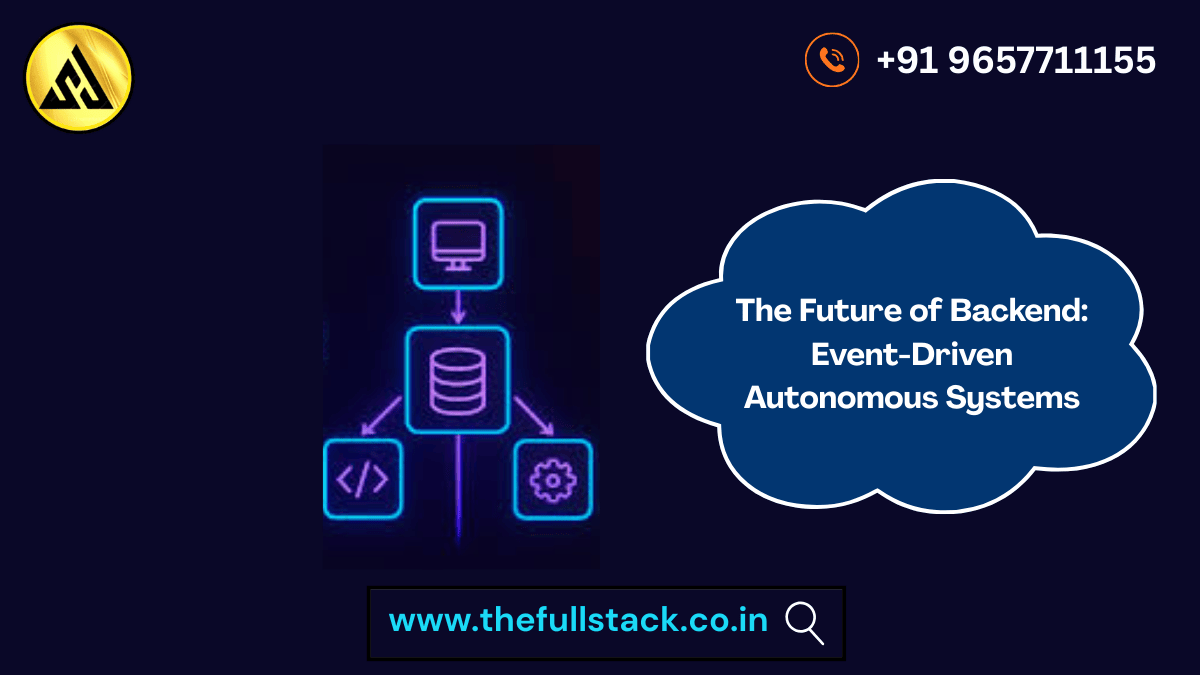
The Future of Backend: Event-Driven Autonomous Systems
Backend engineering is going through one of the biggest transformations in decades. Traditional server-based models are being replaced by architectures that are faster, smarter, and able to operate without continuous human supervision. This shift is led by Event-Driven Autonomous Systems—a powerful combination of event-driven architecture (EDA), automation, and AI.
For beginners, the concept may sound futuristic, but it’s already embedded in the applications we use every day. From Netflix automatically adjusting video quality to banking apps detecting fraud within seconds, event-driven autonomous systems are quietly powering the digital world.
In this blog, we explore what these systems are, how they work, and why they represent the future of backend engineering.
What Are Event-Driven Autonomous Systems?
At their core, Event-Driven Autonomous Systems are backend architectures that react to real-time events and make autonomous decisions based on data, predefined logic, and AI models—without needing manual intervention.
To break it down:
- Event-driven → Everything that happens triggers an event (user action, backend signal, IoT update).
- Autonomous → The system processes, responds, and takes action automatically.
- System → A network of microservices, queues, databases, and AI agents working together.
Imagine this simple example:
A user makes a mobile payment.
→ This triggers an event.
→ A fraud detection service analyzes it.
→ An AI model scores it as low-risk.
→ A payment gateway processes it instantly.
→ Notification service sends confirmation.
All of this happens autonomously, within milliseconds.
This is the power of event-driven autonomous systems—they make applications faster, smarter, and more reliable.
Why the Future Depends on Event-Driven Autonomous Systems
Modern systems must handle:
- Real-time user interactions
- Continuous data streams
- Billions of micro-events per day
- Distributed cloud environments
- High reliability and low latency
- Rapid automation across workflows
Traditional request-response backends cannot scale this efficiently. They rely heavily on synchronous calls and manual intervention.
Event-driven autonomous systems solve this by:
- Processing events asynchronously
- Making decisions independently
- Scaling automatically
- Reducing human dependency
- Lowering operational overhead
Companies like Uber, Airbnb, Amazon, PayPal, and Spotify have already migrated large parts of their backend to event-driven models.
How Event-Driven Autonomous Systems Work
Below is a simplified breakdown for beginners.
1. Events Are Triggered
Anything can be an event:
- User click
- Database update
- API call
- IoT sensor alert
- Inventory change
These events are captured and published in real time.
2. Event Broker Handles Communication
Tools like Kafka, RabbitMQ, or AWS EventBridge pass events between services.
The event broker ensures:
- Events are delivered
- Order is preserved (when needed)
- Services remain loosely coupled
3. Autonomous Services React
Microservices listen to relevant events and act automatically.
Examples:
- Payment service listens for “order_created”
- Notification service listens for “payment_success”
- Inventory system listens for “item_purchased”
These actions occur independently and simultaneously.
4. AI and Automation Add Intelligence
This is where “autonomous” comes in.
AI/ML models can:
- Predict system failures
- Detect anomalies
- Automate responses
- Personalize user experiences
This transforms backend workflows into self-managing systems.
Real-World Use Cases
Smart Supply Chain
Events such as “low_stock” automatically trigger:
- Reorder requests
- Warehouse routing
- Delivery scheduling
Autonomous Banking Systems
Events like “suspicious_transaction” trigger:
- Automated fraud scoring
- Account lock
- Customer alert
Real-Time Streaming Platforms
When millions of users watch videos, the system:
- Adjusts bitrate
- Allocates server resources
- Routes traffic globally
IoT and Smart Homes
When a motion sensor detects movement:
- Lights switch on
- Security camera starts recording
- Home owner receives notification
These responses are instantaneous and autonomous.
Benefits of Event-Driven Autonomous Systems
1. Real-Time Responsiveness
No delays. No waiting for API chains. Events trigger immediate actions.
2. Higher Scalability
Easily handles millions of concurrent events.
3. Reduced Downtime
Autonomous systems recover or reroute automatically.
4. Better User Experience
Personalized, instant, and context-aware responses.
5. Lower Operational Costs
Less manual monitoring and fewer performance bottlenecks.
Key Technologies Behind These Systems
Common tools used in event-driven autonomous architectures:
- Apache Kafka
- AWS Lambda
- Google Cloud Pub/Sub
- Microsoft Event Grid
- NATS
- Kubernetes Event-Driven Autoscaling (KEDA)
- AI-powered anomaly and decision engines
Backend developers who master these skills become highly valuable in modern cloud-native teams.
Trends Shaping the Future
Autonomous Microservices
Microservices with built-in decision-making abilities.
AI Agents for Backend Operations
Multi-agent systems handling logs, failures, scaling, and monitoring autonomously.
Event-Driven Security
AI-powered systems reacting instantly to threats.
Self-Healing Infrastructure
Systems detect faults → reroute traffic → repair themselves.
Event-driven autonomous systems will soon become the default backend pattern for high-scale applications.
Conclusion
The future backend will not just process requests—it will respond to events, make decisions, and adapt on its own. Event-Driven Autonomous Systems represent a major milestone in backend architecture, blending automation, intelligence, and real-time data processing into a single unified approach.
For beginners and professionals, this is the perfect time to explore event-driven patterns, cloud event brokers, and AI-driven automation tools. These skills will define the next decade of backend engineering.
Call to ActionWant to master event-driven architectures, microservices, and autonomous backend systems?
Explore our advanced guides, courses, and developer resources to start building the backend of the future.
YOU MAY BE INTERESTED IN
Table to check whether a business object has any GOS attachment or not
C++ Programming Course Online – Complete Beginner to Advanced

Leave a Reply