
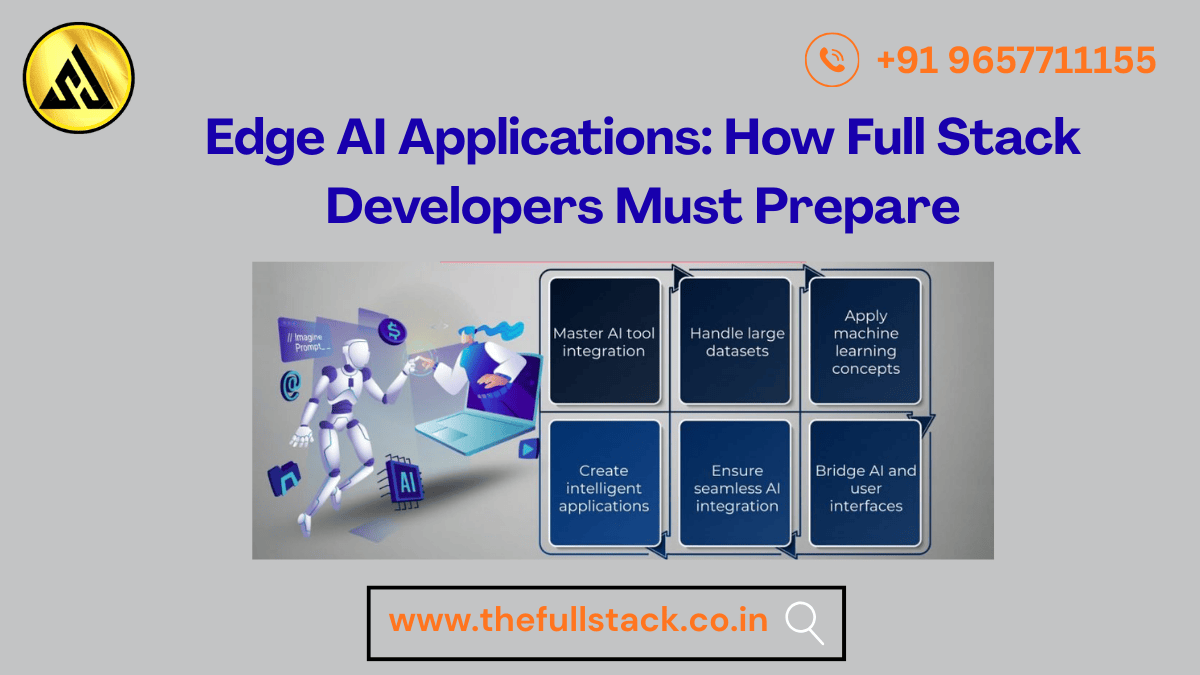
Edge AI Applications: How Full Stack Developers Must Prepare
The world of software development is rapidly shifting, and one transformation leading the way is the rise of Edge AI—AI models deployed directly on local devices instead of relying solely on cloud servers. For many full stack developers, Edge AI is no longer a futuristic technology. It has become a core part of building responsive, intelligent, and real-time applications.
As industries—from retail to healthcare to autonomous transportation—push for faster, more private, and more reliable AI experiences, full stack developers need new skills to stay ahead. In this guide, we’ll dive deep into what Edge AI for Full Stack Developers really means, why it matters, how it’s applied today, and how you can prepare for this fast-growing field.
Understanding Edge AI: A Beginner-Friendly Explanation
Before diving into developer responsibilities, let’s break down the concept using simple language.
Edge AI means running artificial intelligence (AI) models directly on edge devices such as:
- Smartphones
- Cameras
- IoT devices
- Drones
- Wearables
- Industrial sensors
- Smart home devices
Instead of sending data to the cloud for processing, the device itself performs inference (decision-making).
Why does this matter?
Because it enables:
- Extremely fast responses (low latency)
- Higher privacy & security
- Reduced cloud dependency
- Offline or limited-connectivity operation
For full stack developers, this changes application architecture, APIs, deployment models, and performance expectations.
Why Edge AI Matters for Full Stack Developers
Traditionally, full stack developers build web or app systems where the backend handles heavy computation. But with Edge AI:
- AI logic lives closer to the frontend (on edge devices).
- Backend services become coordination layers instead of processing engines.
- Apps must interact with hardware-level AI models.
Edge AI is not replacing cloud AI but complementing it. Full stack developers need to know when to use cloud AI, when to run models on the edge, and how to integrate both in a hybrid system.
Real-World Edge AI Applications Every Developer Should Know
Let’s explore where Edge AI is being used today, with examples full stack professionals often work on.
1. Retail & E-commerce
- Smart shelf monitoring
- AI-powered checkout counters
- Customer flow analytics
- Personalized in-store recommendations
2. Healthcare
- Wearable health monitoring
- Real-time diagnostic assistants
- Smart medical imaging devices
- Remote patient monitoring
3. Autonomous Vehicles & Smart Cities
- Traffic light optimization
- Driver assistance systems
- Road hazard detection
- Drone surveillance
4. Manufacturing & Industry 4.0
- Defect detection on assembly lines
- Predictive maintenance
- Robotics automation
5. Consumer Electronics
- Voice assistants
- Gesture recognition
- AR/VR optimizations
- On-device personalization
These use cases help full stack developers understand where AI might interact with apps, dashboards, APIs, or data pipelines.
How Edge AI Changes Full Stack Development
Edge AI touches both frontend and backend development. Here’s how:
Frontend Side Changes
Developers must now:
- Interact with on-device AI libraries (TensorFlow Lite, ONNX Runtime Mobile)
- Handle real-time data (video, audio, sensor data)
- Build offline-first user interfaces
- Work with hardware constraints (memory, battery, GPU availability)
Backend Side Changes
The backend becomes responsible for:
- Model versioning & distribution to edge devices
- Telemetry & device performance monitoring
- Edge-to-cloud communication
- Managing hybrid AI pipelines
DevOps Changes
CI/CD pipelines must now support:
- Model packaging
- Device firmware updates
- Edge simulation environments
- Performance benchmarking
Essential Skills for Full Stack Developers Entering Edge AI
If you are just beginning your journey, here are the core areas you need to focus on:
1. Understanding AI Models
No need to be a data scientist—but basic understanding of:
- Neural networks
- Training vs inference
- Model optimization
2. Learning Edge ML Tools
Must-know tools include:
- TensorFlow Lite
- PyTorch Mobile
- ONNX Runtime
- Nvidia Jetson SDK
- Apple Core ML
- Google Edge TPU
3. Mastering Real-Time Data Handling
Edge AI often uses video, audio, or sensor streams. Developers must learn:
- WebRTC
- Streaming architecture
- Pub/sub messaging
4. Building Hybrid Cloud + Edge Architectures
Many applications require:
- Cloud model training
- Edge model inference
- Cloud data logging
- On-device updates
5. Improving Performance Optimization Skills
Edge devices have limited resources. Developers must understand:
- Quantization
- Model compression
- Battery and CPU optimization
Current Industry Trends in Edge AI
Edge AI is evolving quickly. Here are the trends shaping its future:
Micro-Models
Smaller, faster, more efficient models designed for edge devices.
On-Device Large Language Models (LLMs)
We are approaching a world where devices run small LLMs locally.
IoT + AI Fusion
IoT devices are becoming both sensors and smart processors.
Federated Learning
Models learn locally and share only insights—not sensitive data.
AutoML for Edge
Automatically optimize models for specific devices.
For full stack developers, these trends mean more opportunities, more demand, and a need for continuous upskilling.
How Full Stack Developers Can Start Preparing Now
Here’s a simple learning roadmap:
Step 1: Learn Basic Machine Learning Concepts
Focus on inference, not training.
Step 2: Experiment with On-Device Models
Run a small image classification model on your phone or Raspberry Pi.
Step 3: Understand API Integration
Connect edge devices to cloud services using MQTT, REST, or gRPC.
Step 4: Practice Performance Optimization
Convert a heavy model into a lightweight, edge-friendly version.
Step 5: Build a Small Edge-to-Cloud Application
Example: A smart doorbell that detects motion via Edge AI and logs data to a cloud database.
Conclusion: The Future Belongs to Developers Who Understand Edge AI
Edge AI is reshaping how full stack developers design and build applications. As computing shifts closer to the user, developers must prepare for a world where intelligence happens everywhere—not just in the cloud.
Learning Edge AI for Full Stack Developers today is your ticket to becoming a future-ready developer capable of building scalable, intelligent, and real-time systems.
CALL TO ACTION
Want to explore more about Edge AI and full stack development?
Start learning with our guided tutorials, beginner projects, and hands-on AI labs to become a next-generation full stack engineer.
YOU MAY BE INTERESTED IN
Table to check whether a business object has any GOS attachment or not
C++ Programming Course Online – Complete Beginner to Advanced

Leave a Reply