
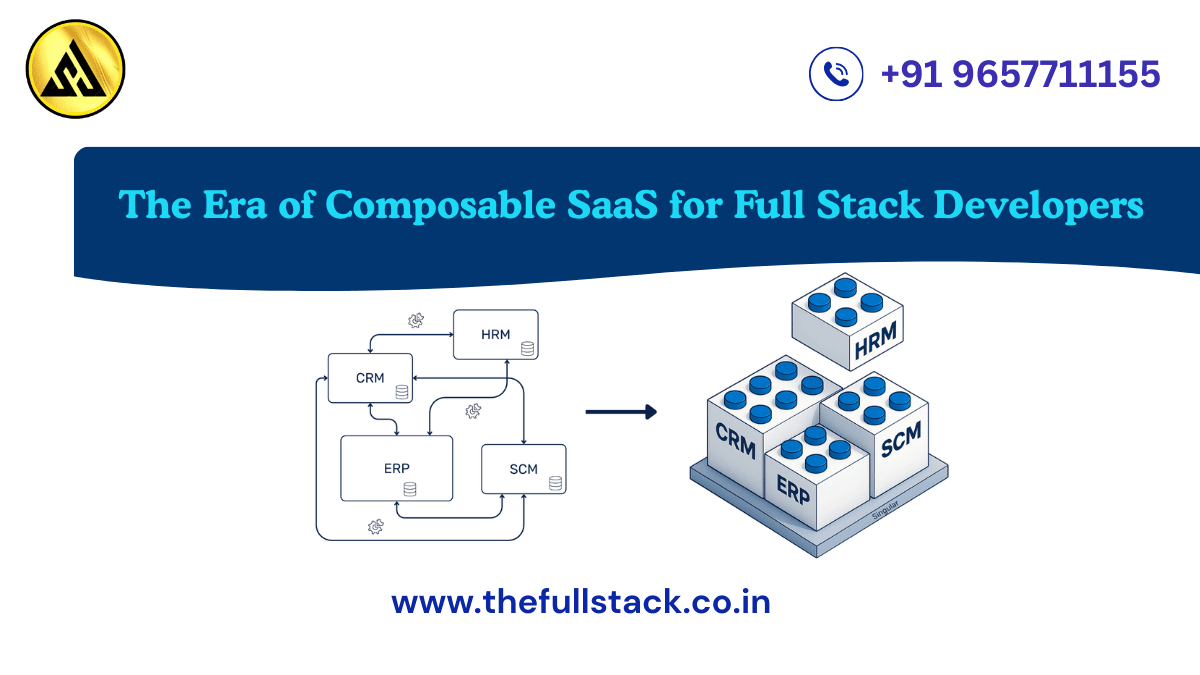
The Era of Composable SaaS for Full Stack Developers
The world of software development has changed dramatically in the past decade. Gone are the days when businesses relied on heavy, monolithic applications that required months of development, painful updates, and large engineering teams. Today, speed, scalability, and flexibility define success — and Composable SaaS is emerging as the new foundation of modern software development.
For full stack developers, this shift represents a powerful opportunity. Composable SaaS allows teams to build applications like assembling LEGO blocks — plug in what you need, extend functionality easily, and scale on demand. Whether you’re a beginner entering the world of full stack development or a company employee trying to understand modern architecture, learning Composable SaaS will help you stay relevant in today’s tech-driven environment.
This article breaks down the concept in simple terms, explains how full stack developers benefit, and explores real-world use cases, trends, and tools shaping the future of composable architecture.
Understanding Composable SaaS: A Beginner-Friendly Explanation
Composable SaaS refers to a modular approach to building software using independent, interoperable components that can be combined, reused, and replaced without affecting the entire system.
Instead of using one giant application, you assemble smaller, specialized SaaS components such as:
- Authentication
- Payments
- Notifications
- Analytics
- Content management
- Search
- AI services
- API integrations
Each of these components works independently but can connect seamlessly through APIs.
Why is this important?
Because it gives developers — especially full stack developers — the freedom to build faster and customize deeply without reinventing the wheel.
A Simple Example
Imagine you’re building an eCommerce app:
- Use Stripe for payments
- Use Firebase for authentication
- Use Algolia for product search
- Use Contentful for content management
- Use SendGrid for emails
Each service is composable. You can swap one out at any time without breaking the whole system.
This is the core principle of Composable SaaS.
Why Composable SaaS Matters for Full Stack Developers
Full stack developers are uniquely positioned to benefit the most from this new software era. Here’s why:
Flexibility Without Complexity
Instead of building everything from scratch, developers can focus on the core business logic while integrating ready-made SaaS services.
Faster Development Cycles
Composable components save time. What once took months can now be built in days.
Easy Integration with APIs
Most SaaS components offer developer-friendly REST or GraphQL APIs, making integration smooth.
Reduced Maintenance
Because each component is independent, upgrades, fixes, or scaling don’t affect the entire application.
Better Scalability
Composable architecture ensures your app grows naturally — add or remove functionality based on user demand.
Improved Reliability
If one composable service fails, it doesn’t break the whole application.
Future-Proof Architecture
Developers can easily replace outdated tools with modern alternatives without rewriting systems.
Key Characteristics of Composable SaaS
Modularity
Each component is isolated, independent, and reusable.
Interoperability
All services communicate through well-defined APIs.
Customizability
Developers can extend or override individual services without affecting others.
Scalability
Each component scales independently based on usage.
Vendor Independence
You are not locked into one ecosystem — you choose the best tool for every function.
How Composable SaaS Enhances Full Stack Development
1. Faster Prototyping and MVP Development
Full stack developers can build MVPs quickly using composable building blocks. This is crucial for startups that want to test ideas rapidly.
2. Cleaner Architecture
Instead of bloated monolithic code, developers maintain clean, organized structures with small, manageable components.
3. Highly Flexible Tech Stack
Developers can mix tools like:
- React for UI
- Node.js for APIs
- Supabase for backend services
- Stripe for payments
- AWS Lambda for serverless logic
This freedom is a dream for full stack developers.
4. Reusability Across Projects
Composable services can be reused across multiple applications, saving time and development effort.
Real-World Use Cases of Composable SaaS
eCommerce
Modern eCommerce stores rely on composable architecture using services like:
- Shopify Hydrogen
- Commerce.js
- Sanity CMS
- Stripe or Razorpay
- Algolia Search
SaaS Platforms
Companies integrate:
- Auth0 for authentication
- Twilio for communication
- Plaid for financial data
- AWS S3 for storage
Mobile Apps
App developers use composable backends like:
- Firebase
- Supabase
- Amplify
- Appwrite
Enterprise Applications
Large enterprises adopt composable SaaS to modernize legacy systems without rewriting everything.
Composable SaaS vs Traditional Monolithic SaaS
| Feature | Composable SaaS | Traditional SaaS |
| Flexibility | Very High | Limited |
| Integration | API-Driven | Fixed |
| Scalability | Independent components | All-or-nothing |
| Vendor Lock-In | Low | High |
| Developer Control | Full control | Restricted |
| Upgrade Complexity | Easy | Difficult |
Composable SaaS clearly wins in modern, fast-paced environments.
Industry Trends Driving Composable SaaS Adoption
1. Rise of API Economy
Every system now communicates via APIs, making composable services easy to plug in.
2. Microservices Growth
Developers already prefer microservices; Composable SaaS extends that logic to SaaS tools.
3. Demand for Faster Launches
Companies want to deliver features quickly. Composable SaaS accelerates delivery.
4. Headless Architecture
Headless CMS, headless commerce, and headless UI align perfectly with composable ecosystems.
5. AI-Powered SaaS Components
Developers now integrate AI features through SaaS tools like:
- OpenAI APIs
- Pinecone
- Hugging Face
- LangChain tools
AI itself is now composable.
Tools and Platforms Supporting Composable SaaS
Some popular platforms include:
- Supabase
- Firebase
- Strapi
- Sanity
- Appwrite
- Vercel
- AWS Amplify
- Auth0
- Stripe
- Shopify Hydrogen
- Twilio
These tools provide modular services that developers can pick and integrate.
Beginner Tips for Mastering Composable SaaS as a Full Stack Developer
Learn API Integration Basics
REST, GraphQL, OAuth authentication — these are essential skills.
Pick the Right Tools
Use tools that match your project scope, not the trend.
Start With Small Components
Begin with authentication, payments, or CMS integration.
Learn Serverless
Serverless functions complement composable architecture beautifully.
Focus on Security
Each SaaS component should be secure and trustworthy.
The Future of Full Stack Development is Composable
Composable SaaS is not just a trend — it’s the future. The demand for fast, scalable, and modular applications will only increase. Developers who understand composable architecture will be at the forefront of innovation.
As businesses continue to embrace digital transformation, full stack developers capable of building with Composable SaaS will be invaluable.
Conclusion: Begin Your Composable SaaS Journey Today
The era of Composable SaaS empowers developers to build smarter, faster, and more scalable applications. It eliminates heavy development processes, unlocks flexibility, and supports modern digital experiences across industries.
If you’re ready to level up your development skills, start exploring composable tools, APIs, and integrations today. Your next project could be the beginning of a fully modular, future-proof application.
Start learning, experimenting, and building — the future of development is composable.
YOU MAY BE INTERESTED IN
Table to check whether a business object has any GOS attachment or not
C++ Programming Course Online – Complete Beginner to Advanced

Leave a Reply