


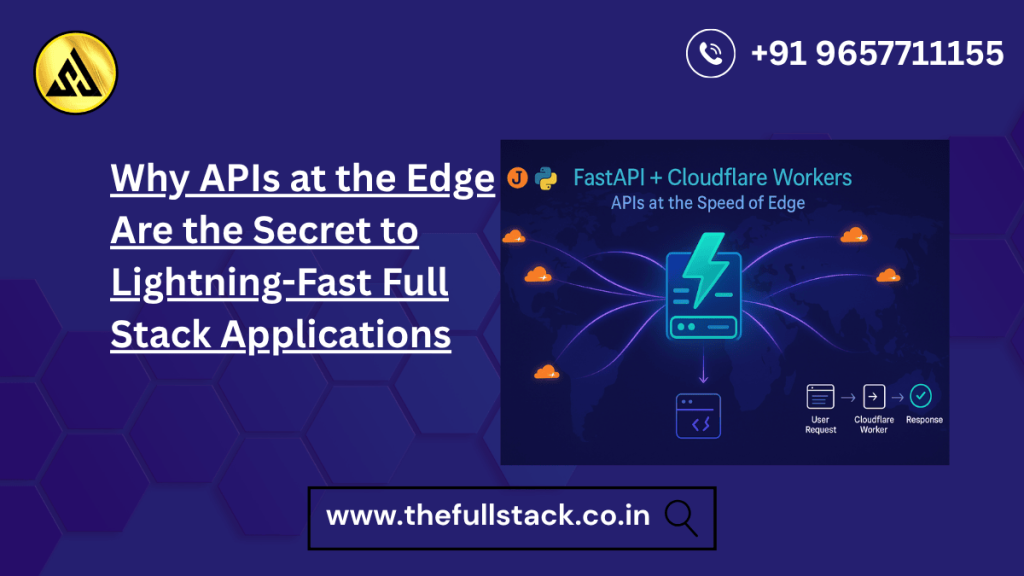
In today’s hyperconnected digital world, users expect instant responses. Whether they’re shopping online, streaming media, or accessing business dashboards, delays of even a few milliseconds can break engagement. Modern developers are under pressure to deliver lightning-fast performance without compromising reliability or scalability. This is where APIs at the Edge come into play—a technological evolution transforming the way full stack applications are built and delivered. If you’ve ever wondered how global apps like Netflix, Shopify, or Slack manage to feel instantaneous, the secret often lies at the network’s edge. Understanding this concept is key to mastering performance in the modern web landscape.
To appreciate the power of APIs at the Edge, we first need to understand what “the edge” means. Traditionally, applications relied on centralized servers located in a single data center. When a user from another part of the world requested data, it had to travel thousands of miles across the internet, introducing latency and slowing down load times. The “edge,” in contrast, refers to servers strategically distributed across multiple global locations—closer to users. When APIs are deployed at these edge locations, data requests and responses occur much faster because the computation happens locally rather than traveling to a distant origin server.
Think of it like ordering coffee. In the old model, you’d have to wait for your favorite café on the other side of the city to make and deliver your drink. With edge computing, there’s a branch of the same café right around the corner, ready to serve you instantly. By bringing APIs physically closer to users, developers can reduce latency, enhance reliability, and ensure that applications remain responsive no matter where users are located.
The rise of APIs at the Edge has coincided with a broader movement toward distributed computing and serverless architectures. Major platforms like Cloudflare Workers, AWS CloudFront Functions, and Fastly Compute@Edge allow developers to deploy code and APIs directly to edge nodes worldwide. Instead of relying on a single central server, your application logic runs across hundreds of edge servers that automatically handle requests from the nearest location. This decentralization means faster responses, lower bandwidth costs, and a better user experience—especially for applications that serve a global audience.
For full stack developers, this approach is nothing short of revolutionary. Traditional web stacks required complex infrastructure management—load balancers, data replication, caching layers, and monitoring systems. Edge APIs simplify this by offloading much of that complexity to the network layer. When your API is distributed globally, users connect to the nearest edge node, which can process the request, access cached data, or communicate efficiently with the origin server when necessary. The result is a seamless experience that feels instantaneous from any location.
Speed, however, is just one part of the story. APIs at the Edge also bring scalability and resilience to full stack applications. When demand surges—say during a product launch or a viral campaign—edge nodes automatically share the workload, preventing bottlenecks. If one server goes down, nearby nodes can instantly take over, ensuring uninterrupted service. This kind of reliability used to require expensive infrastructure and teams of DevOps engineers. Now, it’s baked right into edge networks by design.
Another game-changing benefit of APIs at the Edge is personalization. Modern users expect content tailored to their location, device, and preferences. With edge computing, developers can execute logic closer to the user, enabling dynamic experiences without sacrificing speed. Imagine a global e-commerce platform that automatically displays local currencies, nearby store inventory, or region-specific offers—all processed at the edge. That’s personalization at scale, powered by proximity.
The business impact is undeniable. Studies show that even a 100-millisecond delay in load time can reduce conversion rates by 7%. With APIs at the Edge, organizations can eliminate those costly delays and deliver experiences that feel truly instantaneous. Moreover, this approach reduces the strain on origin servers, cutting infrastructure costs while improving reliability. In the age of cloud-native applications, edge computing is not just an optimization—it’s a competitive advantage.
Developers, too, benefit immensely from this paradigm shift. Modern frameworks like Next.js, Remix, and SvelteKit are already integrating edge capabilities directly into their deployment pipelines. This means you can build APIs that automatically deploy to the edge, scaling globally without extra configuration. Tools like Vercel Edge Functions or Netlify Edge Handlers make it easy for developers of all levels to experiment with and adopt this model. The learning curve is flattening, and the performance gains are tangible from day one.
From a technical standpoint, APIs at the Edge use lightweight serverless functions that respond to HTTP requests. These functions can handle authentication, data fetching, caching, and even transformation of responses—all before the request ever reaches your central database. When paired with global content delivery networks (CDNs), they form a powerful combination: static content and dynamic APIs working together at the edge for optimal performance. For example, a news platform can serve personalized headlines based on a user’s region while ensuring that every page loads almost instantly.
Industry trends indicate that this edge-first approach is rapidly becoming the norm. Gartner predicts that by 2026, 75% of enterprise-generated data will be created and processed outside traditional data centers or cloud environments. Companies that adopt edge API strategies early are positioning themselves to stay ahead of the curve—offering faster services, reducing costs, and delivering superior user experiences. Startups and enterprises alike are already leveraging this to power fintech dashboards, gaming platforms, AI-driven recommendation engines, and IoT applications.
Of course, adopting APIs at the Edge also means thinking differently about application design. Developers must plan for distributed data synchronization, consider latency-aware logic, and ensure that edge deployments are secure. The good news is that modern platforms provide robust tools and abstractions to simplify this process. Security measures like zero-trust access, TLS encryption, and built-in rate limiting are often integrated directly into edge networks, protecting APIs and data without adding complexity.
As the web continues to evolve, users’ expectations for speed and responsiveness will only grow. Whether you’re building a simple website or a complex enterprise application, leveraging APIs at the Edge is one of the most effective ways to meet those expectations. They empower developers to deliver instant experiences, reduce operational overhead, and future-proof their applications in a world where milliseconds matter.
Imagine a future where your application responds before users even realize they made a request. That future is closer than you think—and it starts by moving your APIs to the edge. The organizations that understand and embrace this shift today will be the ones leading tomorrow’s digital landscape.
If you’re ready to dive deeper into how APIs at the Edge can transform your full stack development workflow, explore our advanced guides, online courses, and expert-led tutorials available on our website. Learn how to deploy your first edge API, optimize it for global performance, and build web experiences that truly set the standard for speed and innovation. The edge isn’t just the future of the web—it’s the present, and the time to embrace it is now.
you may be interested in this blog here:-
What’s the difference between Treasury bonds, notes, and bills
Can I Open a Brokerage Account for My Child
What is the Contrast Between Favored Stock and Normal Stock?
Frequently Asked Questions
What are APIs at the edge and how do they improve application performance?
APIs at the edge refer to the deployment of APIs at the edge of the network, closest to the users, which reduces latency and improves application performance. This approach enables faster data processing and reduces the time it takes for data to travel between the user and the application. As a result, applications become more responsive and provide a better user experience.
How do APIs at the edge differ from traditional API deployments?
Traditional API deployments typically involve deploying APIs in a centralized location, such as a data center, which can lead to increased latency and slower application performance. In contrast, APIs at the edge are deployed closer to the users, which reduces latency and improves application performance. This approach also enables more efficient use of network resources and reduces the load on centralized infrastructure.
What are the benefits of using APIs at the edge for full stack applications?
Using APIs at the edge for full stack applications provides several benefits, including improved application performance, reduced latency, and enhanced user experience. It also enables developers to build more scalable and efficient applications, and reduces the load on centralized infrastructure. Additionally, APIs at the edge can help improve application security and reduce the risk of data breaches.
How do I get started with deploying APIs at the edge for my full stack application?
To get started with deploying APIs at the edge, you need to choose a suitable edge computing platform and API management solution that meets your application’s requirements. You should also consider factors such as security, scalability, and performance when designing and deploying your APIs at the edge. Additionally, you may need to modify your application’s architecture and code to take advantage of the benefits of APIs at the edge.
What are some common use cases for APIs at the edge in full stack applications?
Common use cases for APIs at the edge in full stack applications include real-time data processing, IoT applications, and applications that require low latency and high performance, such as gaming and video streaming. APIs at the edge can also be used for security and authentication purposes, such as verifying user identities and detecting potential security threats. Additionally, they can be used for content delivery and caching, which can improve application performance and reduce latency.