
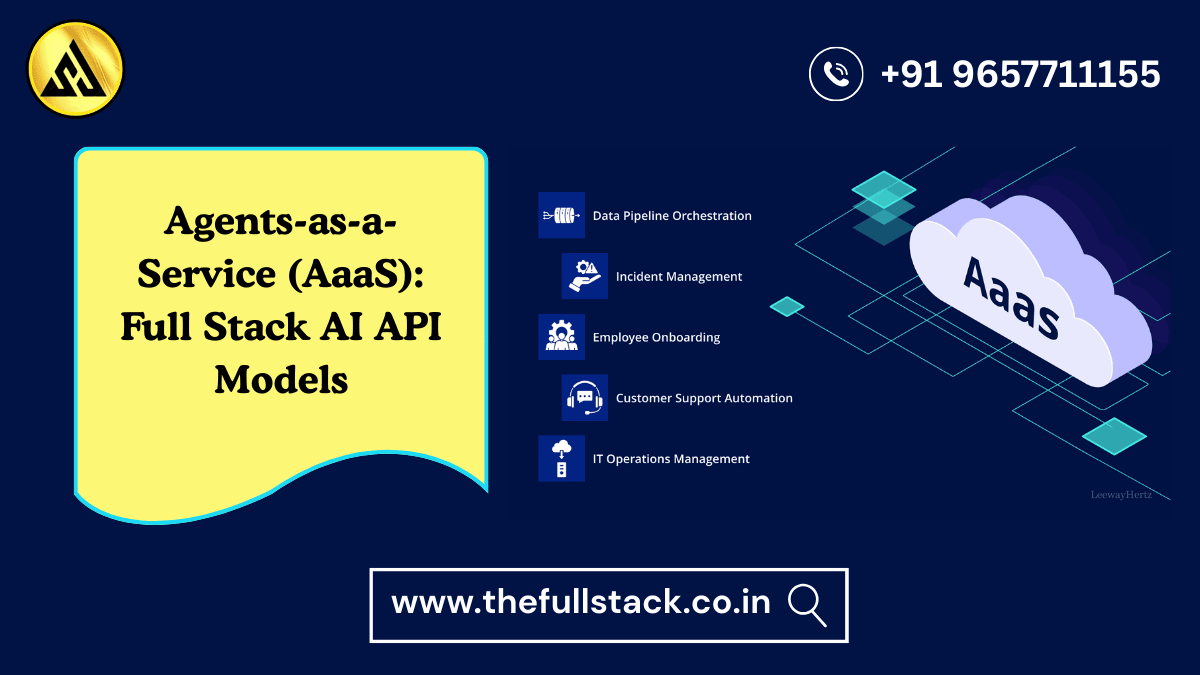
Agents-as-a-Service (AaaS): Full Stack AI API Models
AI is no longer a futuristic idea — it’s now a core part of how companies build, deploy, and scale digital applications. While traditional machine learning required large data teams and months of engineering work, the rise of Agents-as-a-Service (AaaS) is transforming the industry by making AI accessible, modular, and developer-friendly.
With AaaS, developers can integrate fully autonomous AI agents into any application using simple APIs. These agents think, reason, take actions, automate workflows, and even interact with external systems. For full stack developers, this is revolutionary: instead of building complex AI logic, they can now “plug in” intelligent behavior like any other service.
This blog breaks down AaaS in the simplest way possible — perfect for beginners, tech learners, and company teams exploring AI adoption.
What Is Agents-as-a-Service? (Beginner-Friendly Definition)
Agents-as-a-Service (AaaS) refers to cloud-based AI agents that perform tasks autonomously and are accessible via APIs.
These AI agents can:
- Analyze data
- Make decisions
- Perform multi-step workflows
- Interact with other systems
- Trigger actions based on logic
- Automate processes end-to-end
They act as digital employees built into your application.
A Simple Analogy
If typical APIs are functions, AI agents are entire workers.
You don’t just call an endpoint — you assign a task.
The agent interprets the goal, reasons steps, executes tasks, and returns results.
Example
Instead of writing a long script to process orders, send emails, and update CRM:
Agent Task:
“Process today’s orders and notify customers of shipping updates.”
The agent handles everything automatically.
Why AaaS Matters for Full Stack Developers
Full stack developers now need to deliver intelligent features: AI chat, automation, search, recommendations, data analysis, predictions, and more. Building all of this manually is nearly impossible.
AaaS solves this by providing:
1. Ready-Made Intelligence
Agents can reason, plan, and automate without developers writing AI code.
2. API-Based Integration
Agents can be added to web apps, mobile apps, backend systems, and workflows with simple HTTP requests.
3. Faster Delivery
Build AI-powered products in hours instead of months.
4. Low Maintenance
The agent logic runs in the cloud; no retraining, scaling, or infrastructure required.
5. Scalable Automation
Agents handle thousands of tasks simultaneously without additional engineering effort.
6. Unlocking New Features
Developers can add features that previously required large AI teams:
- Smart assistants
- Predictive insights
- Customer support automation
- Business workflow orchestration
- Code generation and debugging
- Knowledge-based reasoning
How Agents-as-a-Service Works (Explained Simply)
AaaS platforms typically offer three core components:
1. AI Models
This includes large language models (LLMs) that power reasoning, planning, and natural language understanding.
2. Agent Frameworks
These define:
- memory
- planning abilities
- tool usage
- context storage
- workflows
- integration rules
Developers configure the logic with prompts or agent “profiles.”
3. API Endpoints
Your application sends requests to the agent, such as:
- “Generate a product description.”
- “Create a marketing plan.”
- “Analyze a dataset and provide insights.”
- “Perform this workflow and update the CRM.”
The agent performs the task and returns the output.
Real-World Use Cases: Where AaaS Is Used Today
Customer Support Automation
Agents can act as support assistants:
- answering questions
- creating tickets
- responding to emails
- updating CRM
- escalating complaints
Marketing Automation
Agents generate:
- ads
- blogs
- campaigns
- customer segments
- performance analysis
IT and DevOps
Agents help developers with:
- code debugging
- documentation creation
- CI/CD automation
- log analysis
- cloud monitoring
Business Operations
Agents perform workflows like:
- data entry
- report generation
- invoice processing
- approvals
- decision-making
E-commerce
Agents personalize:
- recommendations
- product descriptions
- dynamic pricing
- customer re-engagement
Healthcare
Agents support:
- patient interactions
- scheduling
- record summaries
- diagnosis assistance
The possibilities are endless because agents can perform multi-step, reasoning-heavy tasks.
Benefits of AaaS for Full Stack AI Developers
1. Unified AI Backend
Developers no longer need to stitch together:
- ML models
- vector databases
- orchestration tools
- reasoning engines
- pipelines
AaaS provides a complete AI stack in one service.
2. Less Code, More Intelligence
Developers focus on frontend, backend logic, and product experience instead of AI engineering.
3. Rapid Iteration
Change agent behavior instantly using:
- prompts
- configuration profiles
- system instructions
- tool definitions
4. Human-Like Workflow Execution
Agents act like team members.
They understand instructions and plan sequences automatically.
5. API-Driven Scalability
Developers don’t need GPUs or ML infrastructure.
The platform handles everything:
- scaling
- performance
- optimization
- security
- updates
AaaS vs Traditional AI Models
| Feature | AaaS | Traditional AI |
| Setup | Zero setup | Complex |
| Skills Required | Beginner-friendly | Requires ML expertise |
| Workflow Automation | Built-in | Must build manually |
| Reasoning | Advanced | Limited |
| Scaling | Automatic | Difficult |
| Integration | Simple APIs | Custom pipelines |
| Use Cases | Multi-step workflows | Single-step predictions |
AaaS gives developers a much broader and easier way to add AI to applications.
Architecture of Full Stack AI with AaaS
A typical architecture looks like:
Frontend
- React
- Vue
- Angular
- Flutter
- iOS/Android apps
Backend
- Node.js
- Python
- Java
- Go
- PHP
AI Layer (AaaS)
- Agent models
- Reasoning engine
- Memory modules
- Tool connectors
- Vector search
External Tools
- Databases
- APIs
- CRMs
- Cloud services
Storage
- Postgres
- MongoDB
- Firebase
- Supabase
Agents orchestrate the entire flow, providing intelligence to both frontend and backend.
Industry Trends Driving AaaS Adoption
Trend 1: Demand for Autonomous Workflows
Businesses want intelligent automation, not just AI predictions.
Trend 2: Explosion of LLM Capabilities
New models allow agents to think deeper, plan better, and act autonomously.
Trend 3: API-First AI Platforms
AI services are shifting to “plug-and-play” integrations.
Trend 4: Multi-Agent Systems
Applications use multiple agents:
- one for reasoning
- one for planning
- one for execution
Trend 5: AI-Native Applications
Apps are being built entirely around autonomous agents.
How Beginners Can Start Learning AaaS
Step 1: Learn API Basics
- HTTP requests
- JSON responses
- Authentication
Step 2: Understand How Prompts Define Agent Behavior
Agents follow instructions in their profiles.
Step 3: Explore OpenAI, Anthropic, or Custom Agent Frameworks
Many platforms provide ready agents.
Step 4: Build Small Projects
Examples:
- AI email assistant
- Knowledge search bot
- Task automation agent
Step 5: Learn Tool Integration
Agents become powerful when connected to:
- databases
- CRMs
- cloud tools
The Future of Full Stack AI with AaaS
AaaS will become the backbone of future applications:
- Websites will have built-in AI agents
- Mobile apps will be autonomous
- SaaS platforms will run workflows automatically
- Developers will shift from building to configuring
The next generation of developers will not just write code — they will orchestrate intelligent AI systems.
Conclusion: Start Building with Agents-as-a-Service Today
Agents-as-a-Service is redefining software development.
With simple APIs, full stack developers can now build intelligent, autonomous applications without AI expertise. Whether you’re a beginner exploring AI or a team member evaluating automation strategies, AaaS provides a powerful, scalable, and future-proof solution.
Now is the best time to learn how agents work, how to integrate them, and how to design AI-driven applications.
Start experimenting, building, and innovating — the future of full stack AI belongs to AaaS.
you may be interested in this blog here:

Leave a Reply