
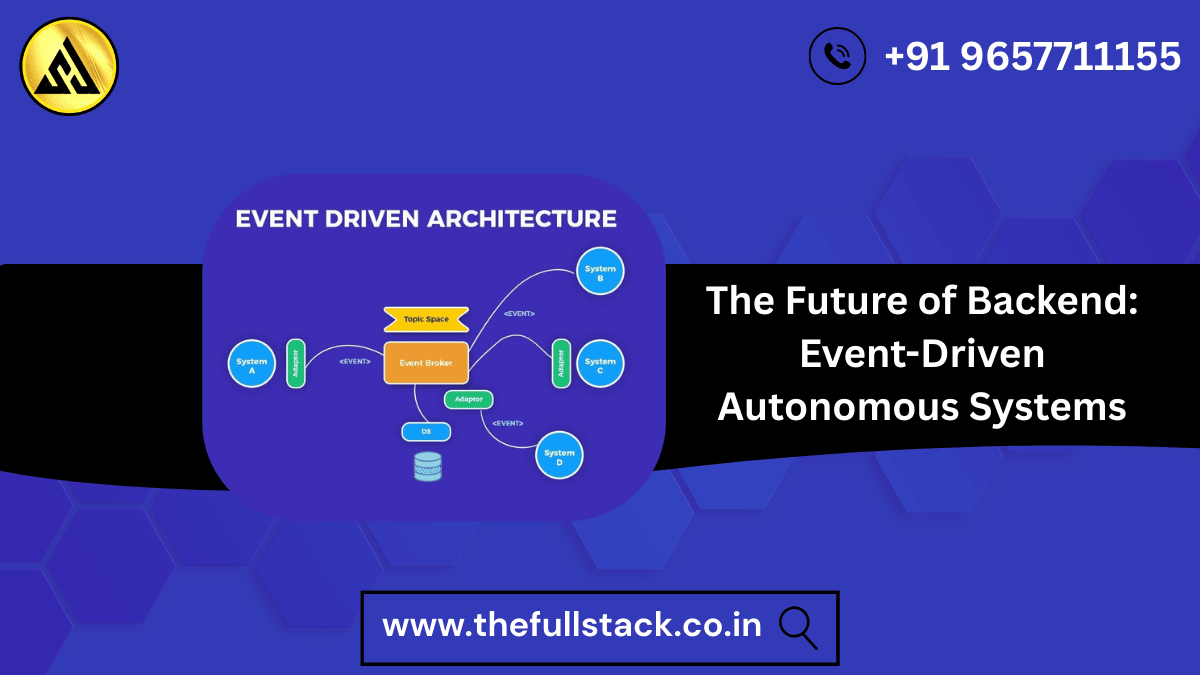
The Future of Backend: Event-Driven Autonomous Systems
The world of backend development is undergoing one of the biggest transformations since the introduction of cloud computing. With applications becoming more distributed, data-heavy, and real-time, traditional request-response architectures are no longer enough. That’s where event-driven autonomous systems step in a new generation of backend design where systems react to events instantly, automate decisions, and operate with minimal human intervention.
In this beginner-friendly guide, we’ll break down what event-driven autonomous systems are, how they work, why they’re shaping the future of backend engineering, and how both new developers and company teams can start adopting them.
Understanding Event-Driven Autonomous Systems
Before diving into the future, it’s important to understand the foundation.
Event-driven autonomous systems combine two major principles:
1. Event-Driven Architecture (EDA)
In EDA, the system responds to events changes in state like:
- A user signs up
- A transaction is completed
- A sensor sends new data
- An error occurs
Each event triggers an action asynchronously, without waiting for other processes. This makes the system fast, scalable, and highly decoupled.
2. Autonomous Decision Making
Autonomous systems use:
- AI/ML models
- rule-based engines
- intelligent orchestration
- automated workflows
…to take actions without human involvement.
Think of a backend that not only receives data but understands what to do with it.
Why the Backend World Is Moving Toward Autonomy
Over the last decade, three major shifts have accelerated the rise of event-driven autonomous systems:
Cloud-Native Microservices
Companies now run hundreds of microservices. Handling communication manually becomes impractical. Event-driven architecture keeps everything loosely connected but perfectly synchronized.
Real-Time User Expectations
From instant payments to live tracking to voice interactions—users expect everything NOW.
Request-response models introduce delays; event-driven pipelines don’t.
Massive Data Growth
Modern systems generate millions of events per minute.
Autonomous processing helps manage, filter, and respond to this data instantly.
AI Everywhere
AI allows backends to detect patterns, predict issues, and automate responses.
Combining AI with events creates truly intelligent systems.
How Event-Driven Autonomous Systems Work
Let’s simplify the flow:
1. Event Occurs
An event is generated like a customer clicking “Buy Now.”
2. Event Stream Receives It
Systems like Kafka, Kinesis, Redis Streams, or RabbitMQ capture events.
3. Consumers React
Microservices consume the event and perform tasks such as:
- Processing payment
- Updating inventory
- Sending notifications
- Logging analytics
4. Autonomous Layer Makes Decisions
This is where intelligence comes in:
- Fraud detection models evaluate the transaction
- Recommendation engines trigger personalized actions
- Reliability systems detect anomalies
- Automated workflows orchestrate the next steps
5. System Learns and Improves
Feedback loops help the backend adapt and self-optimize.
Real-World Examples Beginners Can Understand
Example 1: E-commerce Automation
When a customer places an order:
- Event: “Order Placed”
- Autonomous actions:
- Fraud engine evaluates risk
- Warehouse automation checks inventory
- Logistic AI predicts delivery date
- Notification service sends confirmations
- Fraud engine evaluates risk
No manual process involved.
Example 2: Ride-Sharing App (like Uber)
Events:
- Driver Location Updated
- User Requested Ride
- Trip Completed
Autonomous reactions:
- Matching users to nearest drivers
- Surge pricing adjustments
- Traffic prediction
- Automated payments
Example 3: Smart Homes & IoT
Events:
- Temperature rises
- Motion detected
- Door unlocked
Autonomous systems:
- Adjust thermostat automatically
- Trigger security alerts
- Notify owners through an app
These examples show how event-driven autonomous systems create fast, intelligent, and responsive experiences.
Core Components of Event-Driven Autonomous Backend Systems
To understand it like a professional, let’s break down the major components:
Event Producers
Apps, APIs, sensors, services that generate events.
Event Brokers
Messaging systems that store and distribute events:
- Apache Kafka
- AWS SNS/SQS
- Google Pub/Sub
- Redis Streams
Event Consumers
Microservices that react to events using:
- APIs
- workflows
- AI models
- databases
Autonomous Intelligence Layer
Includes:
- ML pipelines
- rule engines
- anomaly detection
- decision automation
Event Sourcing & CQRS
Event logs are stored to rebuild system state, boosting reliability.
Orchestration Framework
Tools like Temporal, Airflow, Step Functions help automate multi-step workflows.
How Autonomous Systems Improve Backend Architecture
1. Real-Time Decision Making
Systems respond instantly without bottlenecks.
2. Massive Scalability
Each event is processed independently, allowing horizontal scaling.
3. System Resilience
If one service fails, others continue—thanks to decoupling.
4. Cost Efficiency
You only process events when needed, reducing resource waste.
5. Improved User Experience
Instant responses → higher user satisfaction.
Industry Trends Shaping the Future
AI-Native Backends
The backend will become more than logic—it will think, predict, and optimize.
Self-Healing Infrastructure
Systems will detect anomalies and fix themselves automatically.
Event Mesh Architecture
Event streams will flow seamlessly across cloud, edge, and on-prem.
Web3 & Decentralized Event Systems
Blockchain events will power trustless automation.
Serverless Event Automation
AWS Lambda, Google Cloud Run, Azure Functions will dominate due to scale and efficiency.
Practical Use Cases for Companies and Developers
1. Fraud Detection in FinTech
Real-time event evaluation prevents losses.
2. Predictive Maintenance in Manufacturing
Sensors send events → AI predicts failure → system schedules repair.
3. Personalized User Experiences
Recommendation engines respond instantly to user actions.
4. Logistics Automation
Every scan, update, and movement triggers autonomous decisions.
5. Monitoring and Observability
Autonomous systems catch failures before humans do.
How Beginners Can Start Learning Event-Driven Autonomous Systems
1. Learn Event Brokers
Start with:
- Kafka
- AWS SNS/SQS
- RabbitMQ
2. Build a Mini Project
Example:
- “Order placed” → triggers “payment processed” → triggers “email sent.”
3. Use Serverless Functions
AWS Lambda or Firebase Functions for quick event processing.
4. Explore AI Integration
Try simple rule-based automation, then move to ML models.
5. Learn Orchestration
Temporal, Step Functions, or Node.js workflow engines.
Why Companies Should Invest in Event-Driven Autonomous Systems Now
- Reduces operational cost
- Improves user satisfaction
- Boosts scalability
- Enables intelligent automation
- Prepares systems for AI-driven future
Companies that adopt this early will lead the next decade of digital transformation.
Conclusion: The Future Belongs to Intelligent, Event-Driven Backends
The shift toward event-driven autonomous systems is not just a trend it’s the next major evolution in backend engineering. Systems of the future will be:
- faster
- more scalable
- more intelligent
- fully automated
Whether you’re a beginner or part of a corporate engineering team, now is the perfect time to start learning and adopting this architecture. This shift will define the next generation of software, and those who move early will lead the innovation.
Call to Action:
Want to build your skills and stay ahead in backend development? Explore our guides, join our full-stack courses, and start building intelligent event-driven systems today!
YOU MAY BE INTERESTED IN
Table to check whether a business object has any GOS attachment or not
C++ Programming Course Online – Complete Beginner to Advanced
Frequently Asked Questions
What is an Event-Driven Autonomous System in the context of backend development?
An Event-Driven Autonomous System is a design pattern that allows backend systems to operate independently, making decisions based on events and triggers, rather than relying on manual intervention. This approach enables greater scalability, flexibility, and reliability. It’s particularly useful in complex, distributed systems where real-time decision-making is crucial.
How do Event-Driven Autonomous Systems differ from traditional request-response architectures?
Event-Driven Autonomous Systems differ from traditional request-response architectures in that they don’t rely on a centralized controller to process requests. Instead, they use a decentralized approach, where events are published and consumed by autonomous components, allowing for greater concurrency and fault tolerance. This leads to more resilient and adaptable systems.
What are the benefits of using Event-Driven Autonomous Systems in backend development?
The benefits of using Event-Driven Autonomous Systems include improved scalability, increased fault tolerance, and enhanced real-time processing capabilities. They also enable greater flexibility and adaptability, as autonomous components can be easily added or removed as needed. Additionally, they can lead to reduced latency and improved overall system performance.
What are some common use cases for Event-Driven Autonomous Systems in backend development?
Common use cases for Event-Driven Autonomous Systems include real-time data processing, IoT device management, and distributed transaction processing. They’re also well-suited for applications that require complex event handling, such as fraud detection, recommendation engines, and personalized marketing systems. These systems can also be used in areas like logistics, finance, and healthcare.
How do I get started with building Event-Driven Autonomous Systems for my backend applications?
To get started with building Event-Driven Autonomous Systems, you’ll need to choose an event-driven framework or platform that supports your programming language of choice. You’ll also need to design your system’s architecture, identifying the events, triggers, and autonomous components that will make up your system. Additionally, you may want to explore existing examples and case studies to gain a deeper understanding of the design patterns and best practices involved.

Leave a Reply