
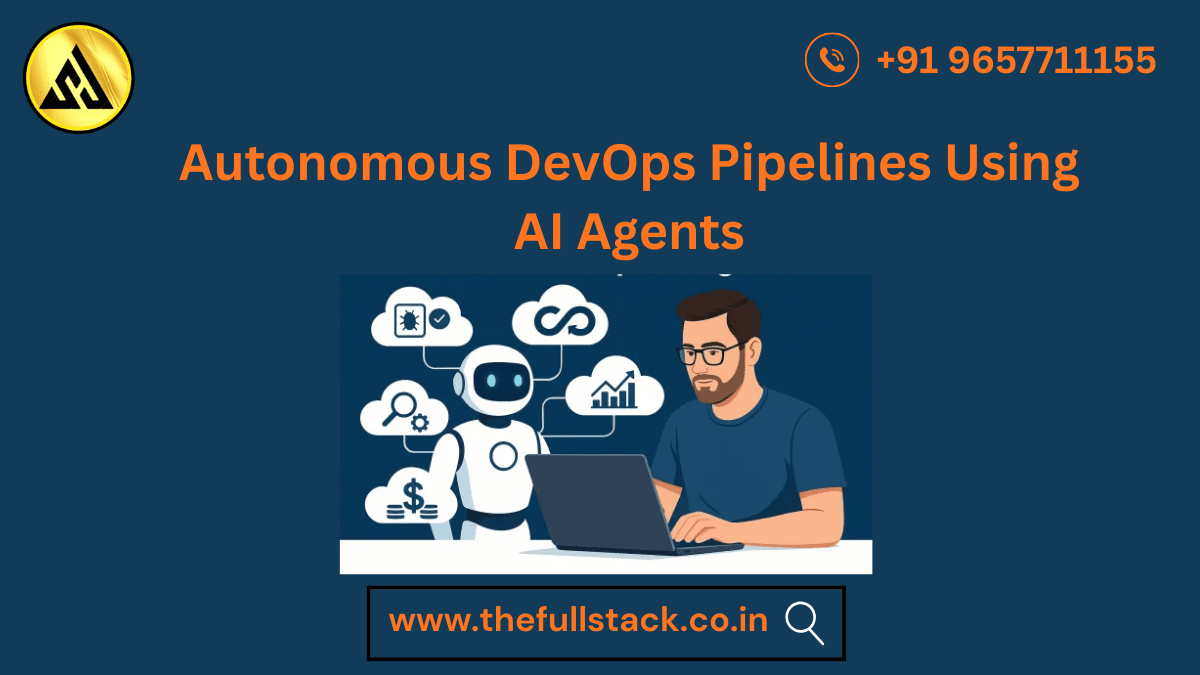
Autonomous DevOps Pipelines Using AI Agents
Modern software development is moving faster than ever. Businesses want rapid releases, stable applications, and efficient workflows—but traditional DevOps pipelines still depend heavily on manual configurations, troubleshooting, and human supervision. In this evolving landscape, Autonomous DevOps Pipelines, our focus keyword, are emerging as the future of CI/CD and software delivery.
Driven by AI agents, these pipelines can independently analyze code, detect issues, trigger tests, deploy applications, respond to incidents, and continuously optimize performance—without manual intervention. Whether you’re a beginner curious about DevOps or an employee exploring advanced automation, this guide breaks down everything in clear and simple terms.
What Are Autonomous DevOps Pipelines?
Autonomous DevOps Pipelines are CI/CD pipelines that use AI agents to automate every stage of the DevOps lifecycle. Unlike traditional pipelines that require manual oversight, autonomous pipelines can:
- Diagnose problems
- Suggest fixes
- Trigger actions
- Make decisions
- Learn from previous patterns
- Self-heal when failures occur
Think of them as intelligent digital engineers working 24/7.
Where traditional DevOps = Automation
Autonomous DevOps = Automation + Intelligence + Decision-Making
This shift revolutionizes how development and operations teams work, freeing humans from repetitive tasks and enabling faster, more reliable software delivery.
Why Autonomous DevOps Pipelines Matter Today
The demand for high-velocity development and stable deployments is exploding. Companies release features weekly, sometimes daily. Manual oversight cannot keep up.
Autonomous DevOps Pipelines solve this by bringing:
- Zero-touch automation
- Self-optimizing workflows
- Predictive error detection
- Continuous learning
- Faster MTTR (Mean Time to Recovery)
- Higher pipeline reliability
AI agents allow teams to scale development without increasing workload.
How AI Agents Power Autonomous Pipelines
AI agents are specialized digital assistants designed to perform intelligent tasks in a DevOps environment. They operate across the entire pipeline.
Here’s how they work in each stage:
Code Stage: AI Code Review Agents
AI agents analyze code quality, detect bugs, verify standards, and identify risky areas.
Example: GitHub Copilot Autofix, automated code suggestion engines.
Build Stage: Intelligent Build Orchestrators
AI agents sense build failures, identify root causes, and retry builds with optimized configurations.
Test Stage: Autonomous Testing Agents
These agents generate test cases, run them autonomously, and prioritize tests based on risk, past failures, and code complexity.
Deployment Stage: AI-Based Deployment Managers
AI agents determine safe deployment windows, monitor pre-deployment signals, and roll out updates gradually using strategies like canary releases.
Monitoring Stage: Predictive Observability Agents
These agents watch logs, detect anomalies, forecast failures, and take corrective actions before the user experiences issues.
Real-World Use Cases of Autonomous DevOps Pipelines
The transition to autonomous pipelines isn’t futuristic—it’s already happening.
Here are real-world examples:
- Netflix uses AI-based chaos engineering tools to self-heal infrastructure.
- Amazon predicts failure points before deploying updates.
- Meta uses ML models to detect and resolve production issues automatically.
- Microsoft Azure uses AI agents to allocate resources and balance workloads.
These examples prove that autonomous pipelines aren’t just a trend—they’re the new standard.
Key Components of Autonomous DevOps Pipelines
To function effectively, autonomous pipelines rely on several intelligent components.
Machine Learning Models
Used for predictions, anomaly detection, and decision-making.
Observability Data
Logs, metrics, and traces feed AI models with continuous feedback.
Event-driven Automation
Triggers allow pipelines to respond instantly to failures or changes.
Policy-as-Code
AI agents follow organizational rules, ensuring compliance and security.
Self-Healing Mechanisms
Automated rollback, restart, or system reconfiguration when issues arise.
Benefits for Teams and Organizations
Adopting Autonomous DevOps Pipelines provides transformational advantages:
- Up to 80% reduction in manual tasks
- Much fewer release failures
- Faster feedback loops
- Reduced downtime and outages
- Better developer productivity
- More predictable releases
- Lower operational cost
AI agents allow teams to focus on innovation instead of firefighting.
Challenges and Limitations
Even the best systems face hurdles. The biggest challenges include:
- Data dependency for training models
- Complex initial setup
- Ensuring AI decisions remain ethical and compliant
- Over-reliance on automation
- Skill gap within teams
However, with proper strategy and training, these challenges can be overcome.
Industry Trends Shaping Autonomous DevOps
Here are emerging trends defining the future:
- Rise of AI Ops (Artificial Intelligence for IT Operations)
- Autonomous cloud platforms
- Self-configuring CI/CD systems
- AI-powered IaC (Infrastructure as Code)
- LLM-driven debugging
- Automated policy enforcement agents
- No-ops infrastructure models
We are heading toward a world where the entire DevOps lifecycle can operate without human intervention.
The Future of Autonomous DevOps Pipelines
The next stage of evolution will include:
- Fully autonomous SDLC pipelines
- Multi-agent collaboration across environments
- Intelligent resource management
- 100% hands-free deployment pipelines
- Risk-aware predictive release planning
Autonomous DevOps Pipelines will become the backbone of future digital enterprises.
Conclusion: It’s Time to Adopt Autonomous DevOps Pipelines
The combination of AI agents and DevOps is shifting how companies build, release, and maintain software. If you’re a beginner exploring the field or a company employee building modern systems, adopting Autonomous DevOps Pipelines is one of the smartest investments you can make.
They save time, boost stability, eliminate repetitive tasks, and accelerate growth.
To continue your learning journey, explore more guides, tutorials, AI automation courses, and DevOps best practices.
What is AWS Lambda?A Beginner’s Guide to Serverless Computing in 2025
Java vs. Kotlin: Which One Should You Learn for Backend Development?
Where to Find Your Salesforce Organization ID
How Salesforce Stands Out from Other CRMs
Frequently Asked Questions
What are Autonomous DevOps Pipelines and how do they use AI Agents?
Autonomous DevOps Pipelines use AI Agents to automate the entire software development and deployment process, enabling continuous integration and delivery without human intervention. AI Agents can analyze code, identify issues, and make decisions to optimize the pipeline. This results in increased efficiency and reliability.
How do AI Agents learn and improve in Autonomous DevOps Pipelines?
AI Agents in Autonomous DevOps Pipelines learn and improve through machine learning algorithms that analyze data from previous pipeline runs, identifying patterns and areas for improvement. As the agents gather more data, they refine their decision-making processes, enabling the pipeline to become more efficient over time. This continuous learning process enables the pipeline to adapt to changing requirements and environments.
Can Autonomous DevOps Pipelines using AI Agents replace human developers and operators?
While Autonomous DevOps Pipelines using AI Agents can automate many tasks, they are not intended to replace human developers and operators entirely. Instead, AI Agents augment human capabilities, freeing them to focus on higher-level tasks such as strategy, innovation, and complex problem-solving. Human oversight and input are still essential to ensure the pipeline is functioning correctly and meeting business objectives.
What are the benefits of using Autonomous DevOps Pipelines with AI Agents?
The benefits of using Autonomous DevOps Pipelines with AI Agents include increased speed, efficiency, and reliability, as well as improved quality and reduced costs. AI Agents can detect and resolve issues quickly, reducing downtime and enabling faster time-to-market for software releases. Additionally, Autonomous DevOps Pipelines can provide valuable insights and data to inform business decisions and drive innovation.
How do I get started with implementing Autonomous DevOps Pipelines using AI Agents?
To get started with implementing Autonomous DevOps Pipelines using AI Agents, begin by assessing your current DevOps practices and identifying areas for improvement. Next, research and select an AI-powered DevOps platform that aligns with your needs and goals. Finally, work with a team of experts to design and implement the pipeline, ensuring that it is integrated with your existing tools and processes.

Leave a Reply