

Node.js Event Loop Explained
Understanding the Node.js Event Loop
Node.js uses the event loop to carry out asynchronous, non-blocking I/O operations, whereas JavaScript is only single-threaded. Whenever feasible, it assigns these tasks to the system kernel. The majority of contemporary operating system kernels are multi-threaded, which enables them to manage several tasks concurrently. The kernel alerts Node.js when an operation is finished so that the relevant callback can be added to the poll queue for execution.
How the Node.js Event Loop Works
The event loop starts as soon as Node.js is initialized, either by running a .js script or in REPL mode. It follows a specific sequence of operations:
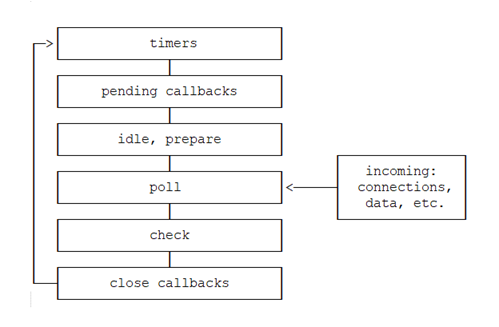
- Timers Phase
- Executes callbacks scheduled by
setTimeout()andsetInterval().
- Executes callbacks scheduled by
- Pending Callbacks Phase
- Executes I/O callbacks that were deferred to the next loop iteration.
- Poll Phase
- Determines how long to block and wait for I/O events.
- Processes events in the poll queue and executes I/O-related callbacks.
- Check Phase
- Executes callbacks scheduled by
setImmediate(). - If the poll phase is idle and scripts are queued with
setImmediate(), the event loop moves directly to this phase.
- Executes callbacks scheduled by
- Close Callbacks Phase
- Handles callbacks registered with the
closeevent, such assocket.on('close', function). - If a socket is closed abruptly, the close event is triggered. Otherwise,
process.nextTick()defers execution to the next iteration of the event loop.
- Handles callbacks registered with the
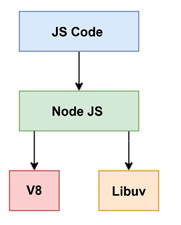
Role of Libuv and V8
- The V8 engine executes JavaScript code.
- The Libuv library enables Node.js to handle asynchronous operations using the system’s native mechanisms.
Event Loop Execution and Shutdown
Node.js looks for scheduled timers or pending asynchronous I/O activities before beginning a new iteration. The runtime ends cleanly if there are none.
The Significance of the Event Loop
Developing scalable and effective Node.js apps requires an understanding of the event loop. It guarantees that the single-threaded execution architecture of JavaScript stays non-blocking, enabling applications to manage concurrent tasks with ease.
It might be helpful:
Best Practices for API Design in Full-Stack Development
What is REST API with an example?
The event loop’s ability to handle multiple tasks concurrently is crucial for developing high-performance Node.js applications. By understanding the different phases of the event loop, developers can write more efficient code and avoid common pitfalls such as blocking the event loop with synchronous operations. This knowledge is essential for building scalable and responsive Node.js applications that can handle a large number of concurrent requests.
In addition to its role in handling asynchronous operations, the event loop also plays a critical role in Node.js runtime execution and shutdown. By understanding how the event loop works and how to use it effectively, developers can build more robust and reliable Node.js applications that can handle a wide range of tasks and use cases, from real-time web applications to microservices architecture and serverless computing.
To take full advantage of the event loop, developers should focus on writing asynchronous code that leverages the power of Node.js’s non-blocking I/O operations. This can be achieved by using built-in functions like setTimeout() and setInterval(), as well as libraries like Libuv, which provide a seamless way to interact with the system’s native mechanisms. By doing so, developers can create high-performance applications that can handle a large number of concurrent requests with ease.
Moreover, understanding the event loop is crucial for identifying and fixing common issues like blocking the event loop with synchronous operations. By recognizing the different phases of the event loop, developers can debug their code more efficiently and write more efficient, scalable, and responsive Node.js applications. With this knowledge, developers can take their applications to the next level and provide a better user experience for their customers, which is essential for building successful and high-performance Node.js applications that can compete in today’s fast-paced digital landscape.

Leave a Reply